

The Dodgers’ Massive Deferral Strategy
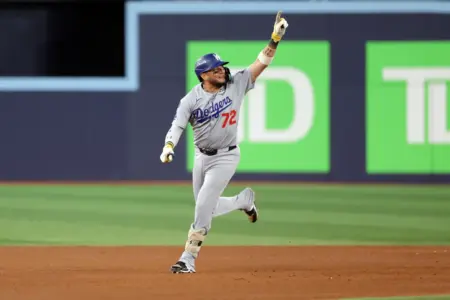
The Los Angeles Dodgers have become a powerhouse in Major League Baseball (MLB) not just because of their on-field prowess, but also due to their innovative financial strategies. As of 2023, the Dodgers owe a staggering $1.051 billion in deferred pay to eight players over the period from 2028 to 2046. This includes significant contracts for Tanner Scott and Teoscar Hernandez. Scott’s four-year, $72 million deal includes $21 million in deferred payments, while Hernandez’s three-year, $66 million contract includes $23.5 million in deferred money. These deferrals are part of a broader strategy that allows the Dodgers to manage their payroll while maintaining a competitive edge.
Commissioner Manfred on the Dodgers’ Competitiveness
Baseball Commissioner Rob Manfred has praised the Dodgers for their competitive spirit, noting that their efforts to field the best possible team align with what fans want to see. "The Dodgers have gone out and done everything possible, always within the rules that currently exist, to put the best possible team on the field. That’s a great thing for the game," Manfred said. However, he also acknowledged the concerns of fans in smaller markets who worry about their teams’ ability to compete financially with the Dodgers. "We try to listen to our fans on topics like this, and I get a lot of emails about it," he added. The commissioner’s comments reflect the delicate balance between promoting competition and ensuring financial fairness in the league.
Detailed Breakdown of Deferred Payments
The Dodgers’ deferred payment obligations are vast and varied. Tanner Scott’s contract includes $21 million in deferred payments, to be made in 12 equal installments of $1.75 million each from 2035 to 2046. Teoscar Hernandez, on the other hand, is owed a total of $32 million in deferred pay. This includes $8.5 million from his one-year, $23.5 million deal for 2024, to be paid in 10 equal installments each July 1 from 2030 to 2039. Additionally, the Dodgers will defer $7.5 million from 2023, $8 million each in 2026 and 2027, and $23.5 million will be paid in 10 equal installments each December 1 from 2030 to 2039.
Other Notable Players and Their Deferrals
The Dodgers’ deferred payment list extends to other star players. Shohei Ohtani, the two-way star, is owed $680 million from 2034 to 2043. Mookie Betts, a key outfielder and infielder, is owed $115 million in salaries from 2033 to 2044, with an additional $5 million of his signing bonus payable from 2033 to 2035. Left-hander Blake Snell is owed $66 million from 2035 to 2046, while first baseman Freddie Freeman is owed $57 million from 2028 to 2040. Catcher Will Smith is owed $50 million from 2034 to 2043, and utilityman Tommy Edman is owed $25 million from 2037 to 2044. These deferred payments are a testament to the Dodgers’ long-term financial planning and their commitment to maintaining a top-tier roster.
Peak Payment Years and Funding Obligations
The Dodgers’ deferred payment obligations peak in 2038 and 2039, with each year totaling $100.95 million. The obligations are relatively low in 2028 and 2029 at $4 million each, and then rise to $7.2 million annually from 2030 to 2032. In 2033, the obligations jump to $17.2 million, followed by a significant increase to $90.2 million in 2034. From 2035 to 2037, the Dodgers will pay $98.95 million annually. After 2039, the obligations gradually decrease, with $98.75 million in 2040, $93.75 million annually from 2041 to 2043, $20.75 million in 2044, and $7.25 million in 2045 and 2046. According to MLB’s collective bargaining agreement, the Dodgers must fund the deferred money in an amount equal to its present-day value by the second July 1 following the season in which it is earned.
Andrew Friedman on Long-Term Planning
Andrew Friedman, the Dodgers’ president of baseball operations, has addressed the long-term nature of these deferred payments. "It’s just how you account for it," he said. "We’re not going to wake up in 2035 and (say): ‘Oh my God, that’s right. We have this money due.’ We’ll plan for it along the way." This statement underscores the Dodgers’ disciplined approach to financial management, ensuring that they can maintain their competitiveness while adhering to the league’s financial regulations. The Dodgers’ strategy is a blend of immediate impact and long-term sustainability, a model that other teams may find increasingly challenging to emulate.