

Understanding the 26-and-Under Power Rankings
The 26-and-under power rankings, a unique twist on traditional farm system evaluations, aim to provide a comprehensive assessment of MLB organizations’ young talent. While standard prospect rankings primarily focus on players who haven’t yet made their major-league debut, these rankings consider all players entering their age-26 seasons or younger, including those already contributing at the big-league level. This approach values proven young big leaguers more heavily than prospects who have yet to demonstrate their capabilities in the majors, offering a clearer picture of each team’s young core. The rankings are scored across four categories: young MLB hitters (0-10), young MLB pitchers (0-10), prospect hitters (0-5), and prospect pitchers (0-5). These scores collectively reflect the team’s potential and present young talent. Yahoo Sports has been covering the 30 MLB organizations, evaluating their 26-and-under talent bases from weakest to strongest leading up to Opening Day. We’ve already covered the five weakest teams (Nos. 30-26), and now, we’re diving into teams 25-21.
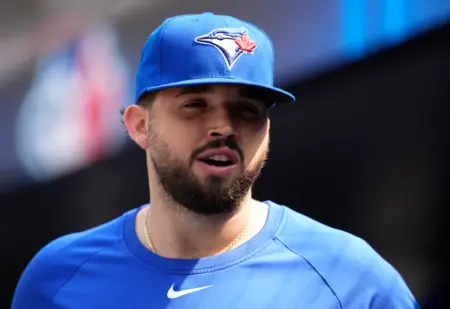
25. Toronto Blue Jays (Total Score: 12/30)
The Toronto Blue Jays boast a solid young hitting core, highlighted by the presence of Vladimir Guerrero Jr., a superstar entering the final year of his contract. Guerrero’s situation is reminiscent of Juan Soto’s with the Yankees, where the inability to secure a long-term deal casts doubt on his future with the team. Nevertheless, his contributions have bolstered the Jays’ offense. Other notable young hitters include Andrés Giménez, who has earned a reputation as one of the best defensive infielders, and Alejandro Kirk, a capable catcher who has shown defensive improvements but needs to recapture his All-Star form. Davis Schneider, Joey Loperfido, Will Wagner, and Leo Jimenez, all acquired in the Yusei Kikuchi trade, bring impressive minor-league pedigrees to Toronto, providing the team with offensive depth. However, the Blue Jays’ pitching prospects are notably thin, with no young arms projected to contribute meaningful innings in the near future. Jake Bloss and Ricky Tiedemann, along with first-round pick Trey Yesavage, are among the few hopefuls, but the overall lack of pitching depth is a significant concern. For the Jays to remain competitive, particularly in a possible post-Guerrero era, they will need to make substantial strides in acquiring and developing young pitching talent.
24. San Francisco Giants (Total Score: 13/30)
The San Francisco Giants find themselves at 24th with a balanced but unremarkable young core. Jung-Hoo Lee, who barely qualifies for the list at 26, faces a crucial season after a shoulder injury hampered his rookie year. The $113 million investment in Lee makes his performance in 2025 pivotal for the Giants. Patrick Bailey and Heliot Ramos are other key offensive players, with Bailey’s defensive prowess and Ramos’s power-hitting potential drawing attention. However, both need to refine their offensive skills to solidify their roles. On the pitching side, Kyle Harrison and Hayden Birdsong have already seen limited major-league action, with Harrison’s rookie season falling short of expectations and Birdsong providing a pleasant surprise. The Giants have several pitchers, including Jose Soriano and Ben Joyce, who could contribute in 2025, but the system lacks high-impact arms. Caden Dana, a late-round draft success, and Sam Aldegheri are among the more promising prospects. The Giants’ strategy of moving players through the system quickly will be tested, and significant investment in scouting and development is essential for their long-term success.
23. Los Angeles Angels (Total Score: 13/30)
The Los Angeles Angels, post-Ohtani era, struggled mightily in 2024, recording their worst season in franchise history. The underdevelopment of key young players like Logan O’Hoppe and Nolan Schanuel was a significant factor. O’Hoppe, once projected as an All-Star catcher, experienced a decline in his offensive performance, while Schanuel, rushed to the big leagues, struggled with power and bat speed. Reid Detmers, who started strong but faltered, adds to the concerns. However, there were bright spots, with Zach Neto emerging as a valuable player and Jose Soriano showing promise as a starter. The farm system has some intriguing prospects, including Caden Dana, who could become a reliable rotation piece, and George Klassen, a high-velocity reliever. Another key player is Sebastian Walcott, an 18-year-old shortstop with the potential to be a franchise-altering star. Despite these talents, the Angels’ future remains uncertain due to their underfunded scouting and development programs. Their aggressive player development strategy, while initially tied to Ohtani, continues to be a debated approach.
22. Texas Rangers (Total Score: 13/30)
The Texas Rangers are one of the more intriguing teams in the 26-and-under power rankings, thanks to a mix of promising young players and high-potential prospects. Wyatt Langford, a Rookie of the Year contender in 2024, had a mixed debut season but showed potential for future stardom. Evan Carter and Leody Taveras, though struggling in recent years, still hold promise. Kumar Rocker, a Vanderbilt product, is the most likely pitcher to make the team out of spring training, with his stuff showing significant improvement. Sebastian Walcott, a Bahamian shortstop, is one of the most exciting prospects in baseball, despite needing refinement in his swing decisions and facing upper-minors pitching. The Rangers’ farm system is not deep, but the presence of potentially elite players like Langford, Walcott, and Rocker gives the organization hope for a brighter future.
21. Houston Astros (Total Score: 14/30)
The Houston Astros, once a dominant force in the AL West, are undergoing significant changes with the departures of Kyle Tucker, Ryan Pressly, and Alex Bregman. Yainer Diaz, a catcher acquired from Cleveland, has shown promise with his offensive skills, though his defensive development remains a concern. Isaac Paredes, who excels at pulling fly balls, is poised to succeed Bregman at third base, facing substantial pressure to perform. The team’s young pitching core, led by Hunter Brown and Spencer Arrighetti, has shown resilience, with Brown emerging as a mid-rotation starter. While the Astros lack high-end pitching prospects, they have depth with arms like A.J. Blubaugh, who could step up if needed. Cam Smith, a physical first-round pick, is a crucial piece for the future, though his position in the field is yet to be determined. The Astros’ success in developing young talent, despite a thin farm system, will be key to maintaining their competitive edge.
Conclusion
The 26-and-under power rankings offer a nuanced look at each team’s young talent, balancing the contributions of current major-leaguers with the promise of prospects. Teams like the Toronto Blue Jays and San Francisco Giants have solid young hitting cores but are lacking in pitching, while the Los Angeles Angels and Texas Rangers show promise in both areas, albeit with some significant developmental hurdles. The Houston Astros, despite losing key veterans, have a mix of young players and prospects who could help sustain their competitive window. As these teams progress, their ability to develop and integrate young talent will be crucial for long-term success. The journey from these rankings to the big leagues is fraught with challenges, but the potential rewards are immense, making the 26-and-under power rankings a compelling narrative in baseball’s ongoing story.