
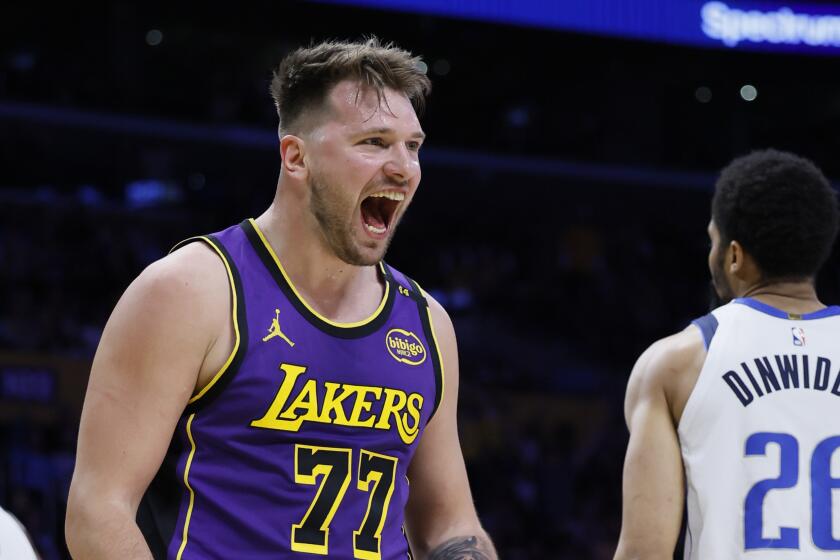
The Night of Emotions
The moment Luka Doncic stepped onto the court for his first game against the Dallas Mavericks, the air in the arena crackled with anticipation. The crowd, buzzing with energy, seemed to be holding its collective breath, hoping to witness a clash of titans. Every crossover, every shot, and every rebound was met with a deafening roar, creating an atmosphere that felt like the playoffs, even though it was only the first quarter. The stakes were high, and the tension palpable, as fans and players alike knew they were witnessing a significant moment in NBA history.
The Main Attraction Struggles
Despite the electric atmosphere, the night proved to be a challenging one for Doncic. Fresh off his best game as a Laker, where he scored 32 points against Denver, Doncic found himself struggling to find his rhythm. The Mavericks, his former team, were relentless in their defense, swarming him with wave after wave of defenders. Doncic’s attempts to break through were mostly unsuccessful, and his shot-making was off. One of his few successful shots—a stepback three-pointer on the left side near the Lakers’ bench—was ultimately nullified by a replay that showed he had been out of bounds. By the end of the game, he managed to make only six of his 17 field goal attempts. Doncic described the game as feeling "weird," admitting that at times, he "didn’t know what [he] was doing."
A Team Effort
While Doncic grappled with his struggles, his teammates rose to the occasion. The Lakers, true to their word, provided the support Doncic needed. Dorian Finney-Smith, a former Laker now playing for the Mavericks, did the little things that often go unnoticed but are crucial to a team’s success. He grabbed a huge rebound on a rare LeBron James miss, set a perfect screen for a Doncic layup, made a great defensive rotation, and pulled off a clutch steal. On the other end, LeBron James, the veteran star, took over the game in the fourth quarter, scoring 16 points through a mix of lobs, tips, and drives. His leadership and composure were instrumental in keeping the Lakers’ momentum going.
A Balancing Act
Despite Doncic’s shooting woes, the Lakers managed to build a 16-point lead midway through the second quarter. Their defensive effort, which has been one of the best in the NBA for over a month, played a pivotal role. Max Christie, a key player for the Mavericks, provided a spark with a crucial block and a couple of three-pointers late in the first half. However, the Lakers’ defense remained relentless, scrambling and adjusting to every offensive move the Mavericks made. The game saw intense back-and-forth action, with Kyrie Irving and Klay Thompson bringing the Mavericks back to a tie score in the fourth quarter. But it was James’ offensive dominance in the final moments that secured the victory for the Lakers.
A Tale of Resilience
Doncic’s perseverance was evident in the way he continued to battle throughout the game. Even with his shooting struggles, he managed to contribute in other ways, finishing the game with a triple-double: 19 points, 15 rebounds, and 12 assists. His all-around effort and leadership were crucial, especially in a game where his team needed him to step up in different areas. The Lakers’ recent form, having won 13 of their last 16 games, reflects their resilience and ability to adapt to different challenges. This victory against the Mavericks further solidifies their position as a formidable force in the league.
A Night to Remember
The evening was a testament to the unpredictable nature of basketball and the power of teamwork. Despite Doncic’s initial struggles, the Lakers’ collective effort and the support from their fans made the difference. The game also highlighted the importance of adaptability and resilience, qualities that are essential for success in the NBA. As the Lakers continue their journey, this victory against a familiar foe will no doubt be a memorable one, a reminder that even on nights when the main star is off, the team can still come together to achieve great things.