
NBA’s Collective Bargaining Agreement and Its Impact on High-Payroll Teams
When the NBA implemented the latest collective bargaining agreement, the introduction of two restrictive salary aprons sent a strong message to teams willing to exceed them: there will be significant consequences. These aprons have made teams more wary of operating with bloated payrolls, given the numerous challenges they face, such as 100% salary matching in trades, the inability to acquire players via sign-and-trade, and various salary aggregation limitations. These restrictions are designed to promote contract efficiency, ensuring that teams do not overcommit to players who may not perform up to their contractual value. For a franchise like the Philadelphia 76ers, this has created a daunting scenario, as they are currently saddled with one of the worst salary-cap situations in the league.
Embiid’s Contract Extension and Health Concerns
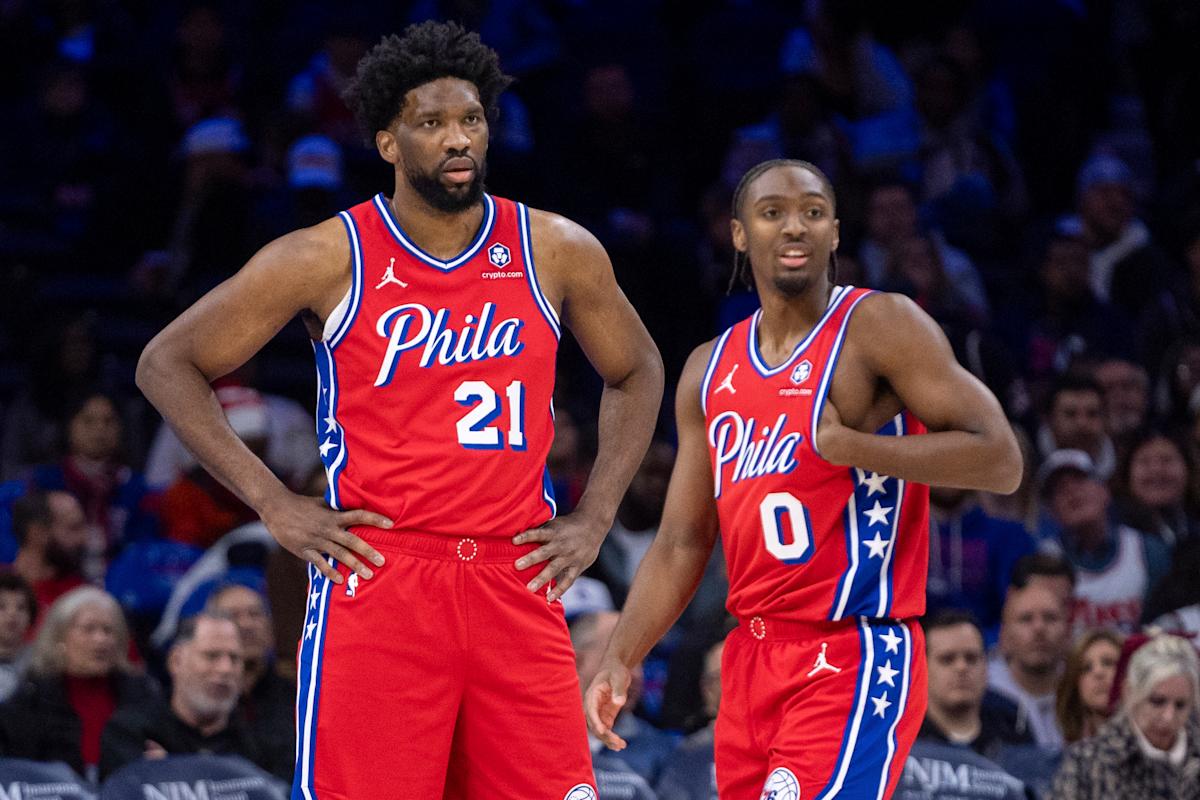
In September, the Sixers extended Joel Embiid’s contract by adding three years and $192 million to his existing deal, which is now set to expire in 2029. Embiid, who is currently the highest-paid player in the NBA, will earn over $69 million in the final year of his extension. The star center’s recent shutdown due to a left knee issue has only exacerbated the concerns about his long-term health. Embiid, who turns 31 on March 16, has a history of health issues and has even stated that he might never play back-to-back games again for the rest of his career. Despite his MVP-caliber performances in the past, the question remains whether he can return to All-NBA form or even maintain half a season’s worth of play. The Sixers are thus faced with a significant risk, as Embiid’s contract becomes a liability if his health and performance continue to decline.
Paul George’s Max Contract and Performance Decline
Compounding the Sixers’ salary cap woes is the four-year, $211.5 million max contract they awarded to Paul George in July. George, who turns 35 in May, has shown signs of a harsh decline in his game, a trend that is likely to continue given his age and injury history. Adding to the frustration is the player option on the final year of his deal, worth $56.5 million, which Philadelphia’s team president, Daryl Morey, inexplicably included. This contract, combined with Embiid’s, has already cost the Sixers over $100.6 million this season alone. Despite their combined contribution of 1,100 points (with George playing 40 games and Embiid 19), the value of their contracts is a major concern. The possibility of George having a bounce-back year in the 2025-2026 season seems unlikely, and the Sixers are left with the burden of carrying two aging stars who may no longer justify their exorbitant paychecks.
Tyrese Maxey: A Bright Spot Amidst the Darkness
Amidst the Challenges posed by Embiid and George’s contracts, the Sixers do have one bright spot: Tyrese Maxey. The 24-year-old signed a five-year, $203.8 million max deal last offseason and has so far proven to be worth every penny. Maxey is a high-caliber All-Star with years of potential ahead of him. His age and performance make him a valuable asset, and the Sixers can take some comfort in knowing that his contract will not overlap with the expiring deals of Embiid and George. However, the real challenge lies in how the organization can build around Maxey while managing the financial and performance burdens of their current stars.
The Draft: A Potential but Unlikely Lifeline
One potential solution for the Sixers is to rely on the draft. However, this path is fraught with uncertainty. The Oklahoma City Thunder currently own Philadelphia’s first-round pick, which is top-6 protected. For the Sixers to retain this pick, they would need to finish in the top 6 of the draft lottery, a tall order given their current performance. The team would essentially have to enter the realm of the Washington Wizards and Charlotte Hornets, who are among the worst in the league, to have any realistic chance of securing a top-6 pick. If they manage to keep the pick and perhaps draft a talented player like Duke forward Cooper Flagg, it could represent a fresh start. Flagg’s rookie extension would not overlap with George’s contract, allowing the Sixers to navigate the late 2020s with more financial flexibility and cap space. Unfortunately, the odds of this scenario unfolding in favor of the Sixers are slim.
The Unspoken Path: Trading Maxey
Given the dim prospects of trading Embiid or George, the Sixers might need to consider a more drastic and uncomfortable measure: trading Tyrese Maxey. If attempts to deal the contracts of Embiid and George fall flat, the organization could explore the market for Maxey, willing to take on bad money in exchange for valuable draft picks. Numerous teams would be interested in acquiring a young, star-caliber player like Maxey, and if the Sixers can time these draft-pick acquisitions to land in the late 2020s, they could enter 2030 with a rejuvenated roster and ample cap space. While this plan might seem like a long shot and would certainly involve a period of struggle, it could be the only viable way for the Sixers to reset their financial and competitive situation.
The Grim Reality for the Philadelphia 76ers
The situation facing the Philadelphia 76ers is remarkably bleak. If Joel Embiid continues to break down and Paul George’s decline persists, the Sixers will find themselves in an unsustainable position, both financially and competitively. In today’s NBA, where contract efficiency is paramount, teams cannot afford to overpay for underperforming stars. The Sixers are already facing a major challenge this season, and the future outlook for change is incredibly small. A turnaround for both Embiid and George would require a near miracle, and the alternative strategies, such as trading Maxey, are fraught with risk and discomfort. The Sixers must navigate these treacherous waters carefully, as the stakes are high, and the path to a competitive future is narrow and uncertain.