
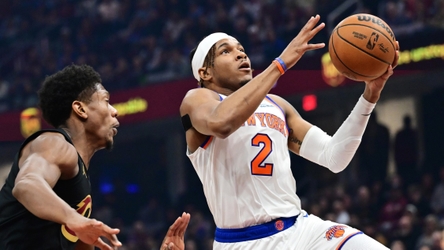
Deuce McBride: A Season of Challenges and Promise
Miles McBride entered the 2024-25 NBA season as a beacon of hope for the New York Knicks, primed for a breakout year after an impressive regular season and playoffs. The trade of fellow guard Donte DiVincenzo, the team’s second-leading scorer from the previous postseason, only amplified the expectations placed on McBride. New York was clearly banking on his continued growth and development, signaling a significant trust in his abilities. However, the season hasn’t unfolded as smoothly as fans and the team had hoped. McBride has been plagued by a knee injury and a subsequent hamstring issue, each costing him five games and disrupting his rhythm. This has unfortunately led to a noticeable decline in his performance, particularly in his shooting, inside finishing, and ball-handling. His minutes have also decreased from 26.4 per game in the first 11 games to 22.7 since, raising concerns about his role and impact on the team.
The Impact of McBride’s Struggles
Despite the setbacks, McBride’s importance to the Knicks cannot be overstated. Even in this "down" year, his presence on the court is a net positive for the team. New York outscores opponents by 4.6 more points per 100 possessions when McBride is on the floor compared to when he’s on the bench. This statistic underscores his value, especially for a team that, while dominant in many areas, still has some glaring weaknesses. For the Knicks to maximize their potential this season, they need McBride to step up his game. The first step in this process is addressing his shooting woes, particularly his deep shooting. Despite the regression, McBride’s three-point shooting is still solid, and he’s attempting a similar number of shots. However, his pull-up three-point shooting, a crucial part of his game and a niche he shares with Jalen Brunson, has dropped from 37.2% last year to 32% this season. This decline has forced teams to adjust less aggressively, reducing the pressure on the Knicks’ defense.
Addressing the Mid-Range and Rim Finishing
There are some positive developments in McBride’s game, notably his improved mid-range shooting. However, perhaps the most concerning drop-off has been his finishing at the rim. McBride’s field goal percentage within three feet of the rim has plummeted from 67.9% last season to 46.7% this year. While there’s no clear indication of a significant change in his approach, the lingering effects of his injuries are likely a factor. The Knicks need to ensure McBride gets more healthy reps to rebuild his rhythm and confidence at the rim. This could be a pivotal factor in his overall performance and the team’s success.
The Need for More Minutes and Trust
Increasing McBride’s minutes and trust in his abilities is a critical step towards his resurgence. McBride himself has cited increased opportunity as a significant factor behind his recent strong performance, including a season-high 23 points and six rebounds in a start against the Chicago Bulls. Other teams’ key sixth men, such as Payton Pritchard, Malik Beasley, and De’Andre Hunter, average over 28 minutes per game, yet McBride has struggled to get consistent minutes, especially given the Knicks’ limited depth. While his minutes have improved slightly in the last ten games, the Knicks have left a lot of potential on the table. A base-level solution is to give McBride more minutes, but the team can also strategically deploy him to maximize his impact.
Creative Lineup Deployment
One way to enhance McBride’s role is to pair him more often with Jalen Brunson. This configuration gives the Knicks two dynamic creators in the same lineup, potentially opening up better opportunities for McBride to shine. Another creative strategy is to start McBride in place of Josh Hart, allowing for a true five-out lineup without sacrificing much defensive capability. Experimenting with McBride and Precious Achiuwa in the lineup, replacing Brunson and Karl-Anthony Towns, has shown flashes of elite defense, but these lineups have only seen limited minutes. These changes could be crucial for a team with limited flexibility to improve their roster in the short term.
Looking Ahead: The X-Factor
As the season progresses, the Knicks will need to rely on the growth and development of their current roster to reach their full potential. Among the key players, Miles McBride stands out as the biggest x-factor. His ability to bounce back from his current struggles and reclaim his form could be the catalyst the Knicks need to elevate their level of play. With the trade deadline behind them and the offseason still on the horizon, New York must find ways to maximize the contributions of McBride and the rest of their roster. By giving him more opportunities, trusting his talents, and deploying him creatively, the Knicks can unlock the potential that made McBride a breakout star in the first place.