
Welcome to the Infinite Paradox
While this may be your first time exploring IN THE FACADE WE TRUST, this dimension welcome anyone—both human and creature. Unravel the tightly wound thread and decide whether you’ll choose left or right, trust the girl or the creature. This unusual game is a labyrinth of choices and consequences, where the line between reality and illusion blurs as you navigate through endlessly looping corridors. Each decision you make plays a pivotal role in the unfolding narrative, leading you to question the very nature of trust and existence.
Plot Overview: A Game of Trust and Choices
IN THE FACADE WE TRUST is a game that draws inspiration from P.T. and Silent Hills, blending the eerie liminal space of the Backrooms with deep psychological elements. The story is set within the context of a domestic massacre that occurred on February 3, 1961. A family was brutally murdered with a kitchen knife by the youngest daughter, Madison. “It’s not my fault. He told me to do it,” she cried out as she killed her mother and sisters one by one. The plot is premeditated, as Madison locked the front door before the murders took place. However, the identity of the person who compelled her is shrouded in mystery. Each cycle of the game reveals more context, leaving you to determine who to trust and what to believe.
Navigating the Endless Corridors
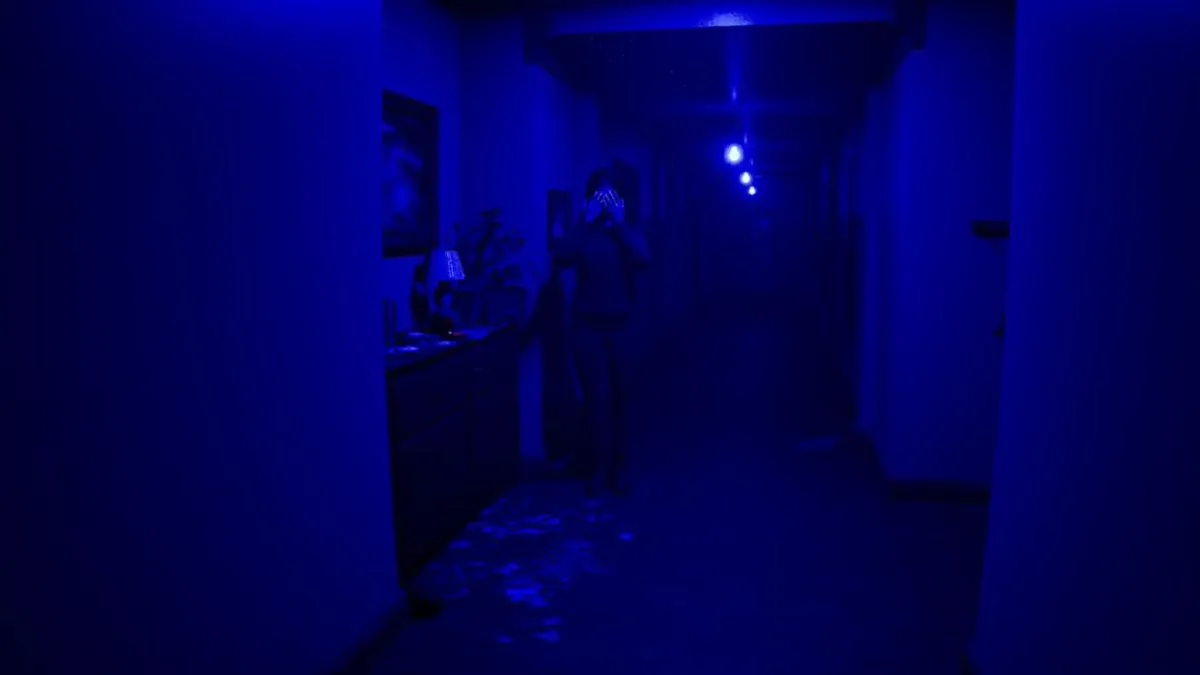
The game begins with a mysterious voice shouting “DON’T” as you exit what appears to be level four of the Backrooms. You quickly realize that this voice is your own, and you are stuck in a time loop. Your objective is to escape the endless corridors, but the path is fraught with enigmas and warnings. The girl, Madison, and the creature are your primary guides. They communicate via an answering machine at the start of each cycle, gradually revealing more about their past and the nature of this dimension. The girl reaches out first, offering to help you. However, as you progress, a single word sprawled across the top of a door—“Evil”—introduces a layer of complexity. Both the girl and the creature provide contradictory advice, making it increasingly difficult to discern the truth.
The Girl: A Manipulated Soul
The girl is revealed to be Madison, the killer from the 1961 massacre. After her arrest, Madison died in her cell, but not before the appearance of a rope, a chair, and an abundance of almond water, a recurring element from the Backrooms. Almond water, often used to restore sanity in Backrooms games, suggests that Madison had some connection to the infinite paradox long before the murders. The notes she left behind indicate that she heard the Wanderer (the protagonist) recount the order in which she killed her family, which she then wrote down and acted upon. This created a paradox, as the thoughts were not her own but planted by the Wanderer. Madison became a Backrooms entity, trapped in a dimension of endless cycles, a manifestation of her own mind. The more unstable the cycles became, the more aggressive and desperate she and the creature grew.
The Creature: A Distorted Guardian
The creature, a terrifying figure with glowing white eyes and an unnatural mouth, is Madison’s father. He ended his life three months after the massacre, and like his daughter, he disappeared into the Backrooms, where almond water appeared once more. The creature claims he isn’t Madison’s father, suggesting he would guide you to your death rather than help you. However, Madison refers to him as “father” at the end of the game, adding another layer of confusion. The creature, now a distorted entity, wants to leave this place and believes you are the key to his escape. He warns you repeatedly about the dangers of trusting Madison, but his advice is met with skepticism and contradiction. The question remains: is the creature lying to you, or is he truly trying to help?
The Ambiguous Endings
IN THE FACADE WE TRUST presents you with two primary endings, both of which are unsettling. Your fate is determined by whether you choose to trust the girl or the creature. If you consistently choose the right path, guided by the creature, you re-enter the Backrooms, continuing the loop. The creature remains with Madison, and the paradox repeats as new versions of you venture in. If you choose the left path, guided by Madison, you face an uncertain fate, likely trapped with her in this dimension. The game’s opening implies that the protagonist always chose the right path, as a version of “you” shouted “DON’T” to warn future iterations away from The Void. Yet, Madison insists that choosing the right path will lead to your death, creating a paradox that challenges the very notion of choice.
Trapped in a Cycle of Manipulation
On the surface, IN THE FACADE WE TRUST offers the illusion of free choice. However, the reality is that both Madison and the creature are manipulating you for their own ends. Madison’s actions were dictated by the Wanderer, and the creature believes you can help him escape the dimension. Regardless of which path you choose, the outcome is bleak. If the entity that compelled Madison to kill her family is truly to blame, then The Void serves as your punishment. The game leaves you with a haunting realization: there is no escape, only death. The voice that shouted “DON’T” might not have been your own, adding to the eerie and unsettling nature of the game’s narrative. IN THE FACADE WE TRUST is a chilling exploration of trust, manipulation, and the inevitability of fate in an infinite, looping dimension.