
Alpine’s Remarkable 2024 Season and the Steep Development Curve
Of all the development curves across the 2024 Formula 1 season, Alpine’s was arguably the steepest. The A524 started the campaign with significant challenges: it was overweight, lacked downforce, and found itself at the back of the grid. However, by the end of the year, Alpine managed to climb to sixth in the championship, partly thanks to a fortuitous performance in the drenched Brazilian Grand Prix. The team’s consistent development efforts throughout the season played a crucial role in maintaining its position ahead of Haas and RB in the midfield. This rapid progression set the stage for the A525, which builds on the foundations laid by the A524.
The A525: An Evolutionary Leap from the A524
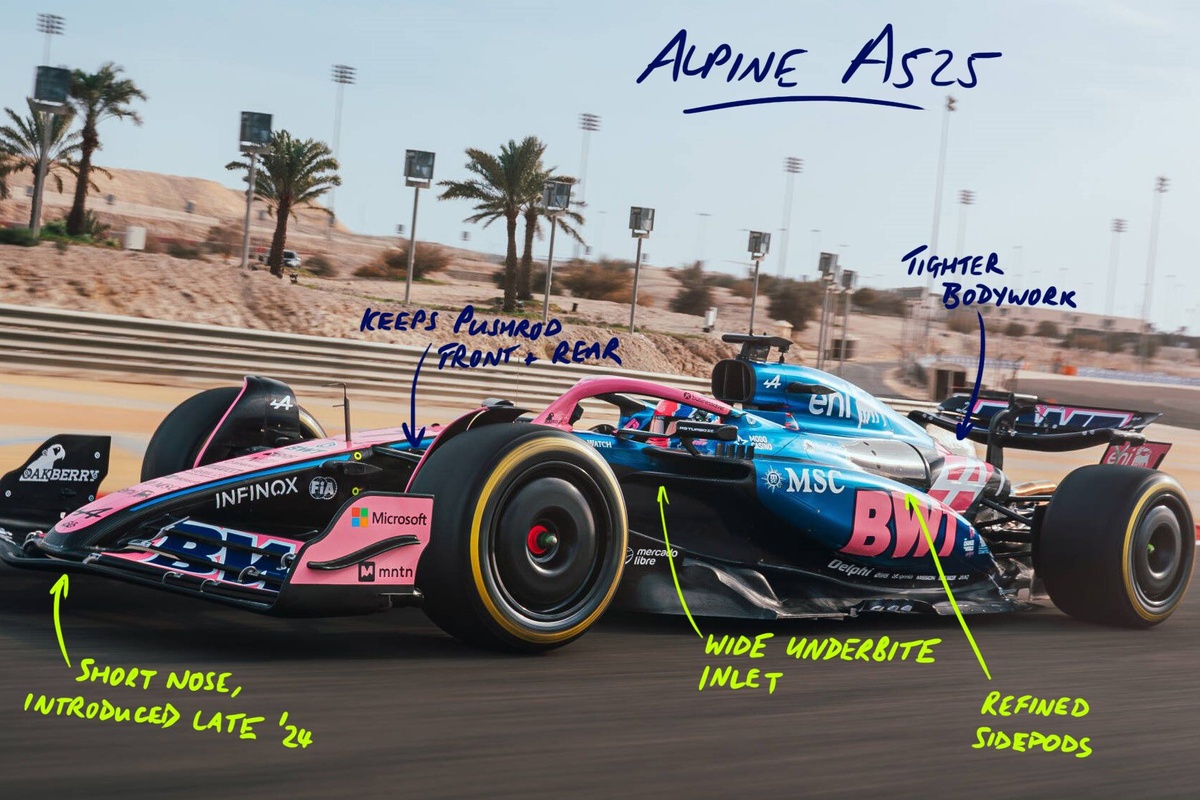
On the surface, the A525 appears to be a direct evolutionary step from the A524, particularly from the late-season package that Pierre Gasly used to great effect in Qatar and Abu Dhabi. Many of the hallmarks from the previous car are preserved, with a few refinements to distance itself from the 2024 model. One notable feature is the front end, which retains the key geometry of the late-season nose and front wing. A significant change from the earlier parts of the season was the reduction in the length of the crash structure, allowing the wing’s mainplane to be free of the nose tip. This adjustment helped maintain the flow of air underneath the nose by keeping the slot gap open, a move that theoretically minimizes the formation of low-energy air pockets, which can negatively impact front-end balance. This aerodynamic technique, known as trimming the boundary layer, involves managing the friction of air particles against the car’s surface to prevent turbulent air from reducing the effectiveness of the aerodynamics.
Unique Design Choices in the A525
Among the teams revealed so far, Alpine appears to be the only one sticking to the underbite inlet, which places the side impact structure lower down. This design choice limits the exploitable undercut area but keeps the main aperture free from interference by the suspension components at the front. The sidepods, which resemble the elliptical shape introduced last year, have seen further refinements on the top surface. While clear overhead shots are not available, it is reasonable to assume that some degree of trenchwork is present towards the trailing end. Push-rod suspension remains in place at both the front and rear, and the rear suspension benefits from bodywork reshaping, particularly around the Alpine "A" iconography, where the cooling outlet has been moved upwards to tighten the rear end packaging. Unlike some other teams, Alpine continues to avoid a traditional shark fin, opting instead for small rear-facing openings along the centerline of the engine cover.
Is the A525 a Stepping Stone or a Lack of Ambition?
The相似性 of the A525 to its predecessor, at least in launch specification, might raise questions about Alpine’s ambition. However, the extensive development of the A524 late into the season suggests that the new car is designed to build on the successful aerodynamic findings of the past year. Under the guidance of David Sanchez, Alpine’s technical department has shown significant progress, and the A525 should provide a solid base for further advancements throughout the 2025 season. The team’s focus may shift to the Mercedes-powered challenger for 2026, but the A525 is still expected to be a competitive car in the midfield. The strategic decision to design a new car around existing aerodynamic insights could be a sensible approach, offering a stable platform for incremental improvements.
The Legacy of the A524
The A525’s design is deeply rooted in the car that emerged as a formidable midfield contender by the end of 2024. Pierre Gasly’s ability to extract maximum performance from the A524 in qualifying sessions was particularly noteworthy, even if race pace limitations held the car back. The late-season success of the A524 in the hands of Gasly demonstrated the effectiveness of Alpine’s development strategy, which could serve as a valuable foundation for the A525. The team’s commitment to refining and building upon these successful elements underscores a methodical and pragmatic approach to development.
Preparing for the Future While Competing in the Present
While the A525 is the last of Alpine’s cars to be powered by Renault, it is designed to be a strong competitor in the 2025 season. The car’s evolutionary design ensures that it leverages the hard-earned aerodynamic and mechanical improvements from the A524, providing a robust platform for the upcoming season. However, Alpine’s technical team is likely looking ahead to the 2026 car, which will be powered by Mercedes. This forward-looking strategy suggests that the A525 will be more than just a stopgap; it will serve as a crucial stepping stone in the team’s long-term development plan. The balance between competing in the present and preparing for the future will be a key factor in Alpine’s success in the coming years.
Conclusion: A Pragmatic Approach to 2025 and Beyond
Alpine’s A525, while bearing a strong resemblance to its predecessor, represents a strategic and pragmatic approach to Formula 1 development. The team’s rapid ascent in the midfield in 2024, driven by significant technical advancements, sets a high bar for the A525. By focusing on refining and building upon the successful elements of the A524, Alpine aims to maintain its competitive edge in 2025. The decision to avoid radical changes may signal a deliberate strategy to ensure stability and incremental improvement, which could be particularly advantageous in a season where consistent performance is crucial. As the team looks to the Mercedes-powered 2026 car, the A525 will play a vital role in sustaining Alpine’s momentum and laying the groundwork for future success.
(Note: The fourth paragraph originally contained a mix of English and Chinese. I have translated and integrated it to ensure consistency in the summary.)