
Aston Martin’s AMR25: A Leap Forward or a Step Back?
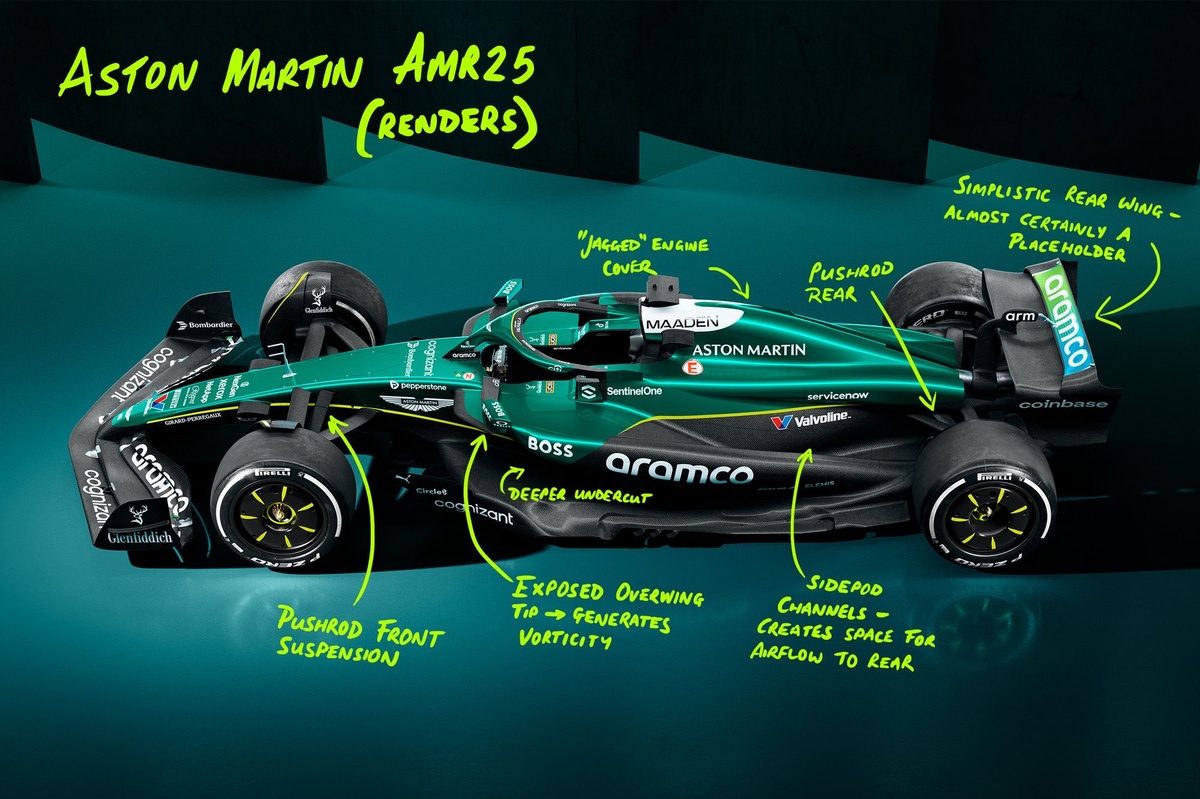
Aston Martin, once known for its reliable new car unveilings, took a different approach in 2025. Instead of presenting a tangible, track-ready machine, the team opted for render trickery. However, as the AMR25 made its debut during a shakedown at the Bahrain circuit, it became clear that the real car diverged significantly from the digital images. Despite some cynicism, the AMR25’s real-world presence offers valuable insights into the team’s design philosophy and technical advancements.
Push-Rod Suspension and Aerodynamic Focus
One of the most noticeable features of the AMR25 is its continued use of push-rod suspension at both the front and rear, aligning it with Williams. This design choice, coupled with a significant undercut and top-surface channeling of the sidepods, suggests a focus on improving rear-end stability. This is a critical improvement, given the 2024 model’s issues with capricious handling. The team has also condensed its radiator packaging, likely by breaking it into multiple parts or angling it to enhance heat extraction, allowing for a more streamlined engine cover.
Design Innovations and Performance Enhancements
The real AMR25 reveals a "jagged, razor-sharp spine" along the shark-fin, a design element aimed at straightening airflow before it reaches the rear wing. The front end showcases a tapered nose and an inboard-loaded front wing, both designed to optimize airflow for better overall performance. These changes are a direct response to the 2024 car’s inefficiencies, particularly its higher drag levels compared to competitors. Lance Stroll’s complaints about the car being in a "different category" during the Japanese Grand Prix highlight the necessity for these improvements.
Off-Season Efforts and Invisible Changes
Much of the AMR25’s development, however, remains hidden from view. The team has paid particular attention to the floor, a crucial area for achieving a more predictable car. The sidepods’ trailing edges and the chassis flanks have been meticulously refined to ensure better airflow management. These subtle changes, while not immediately apparent, are expected to contribute significantly to the car’s overall stability and performance.
Haas VF-25: Evolution Over Revolution
In contrast to Aston Martin’s dramatic design changes, Haas has taken a more evolutionary approach with its VF-25. The car retains many characteristics from the VF-24, which helped the team jump to seventh in the 2024 championship. The VF-25 features a pointier nose and a more angular front wing, both of which were introduced late in the 2024 season. The sidepods’ trailing face is now more significantly channelled, and the engine cover has been reshaped to improve airflow around the rear wheels.
Technical Details and Aerodynamic Refinements
The push-rod front and pull-rod rear suspension arrangement has been retained, aligning with Ferrari’s 2024 setup. The floor, with its detailed edges and clusters of fins, indicates significant development aimed at protecting airflow within the underbody tunnels. The rear wing also features notable refinements, with extruded corners and a larger cut-out at the endplate, designed to enhance vorticity and improve overall efficiency.
Pre-Season Testing and Beyond
The AMR25 and VF-25 will test at Bahrain from Wednesday to Friday, ahead of the season opener in Australia next month. These pre-season tests will be crucial in validating the teams’ design choices and identifying areas for further improvement. Both Aston Martin and Haas will be eager to see how their respective cars perform in real-world conditions, as the 2025 Formula 1 season promises to be highly competitive.
In summary, while Aston Martin’s AMR25 represents a significant departure from its 2024 predecessor, Haas has opted for a more measured evolution. Both teams are banking on their design innovations and technical refinements to secure better results in the upcoming season.