
The Struggle for Consistency
In the world of Formula 1, where every millimeter and microsecond counts, the adage "third time’s the charm" often gives way to "bad luck comes in threes." For Mercedes, the transition has been stark. Despite the W15 winning more races than any other car since 2022, the team found itself a distant fourth in the constructors’ championship, trailing behind McLaren, Ferrari, and Red Bull. This inconsistency was starkly evident, as the W15 often struggled with the delicate balance of maintaining its Pirelli tyres within their optimal temperature range. Under cooler conditions and on smoother track surfaces, the car’s issues were less pronounced, but these ideal conditions were the exception rather than the norm in the 2024 season.
A New Approach to Aerodynamics
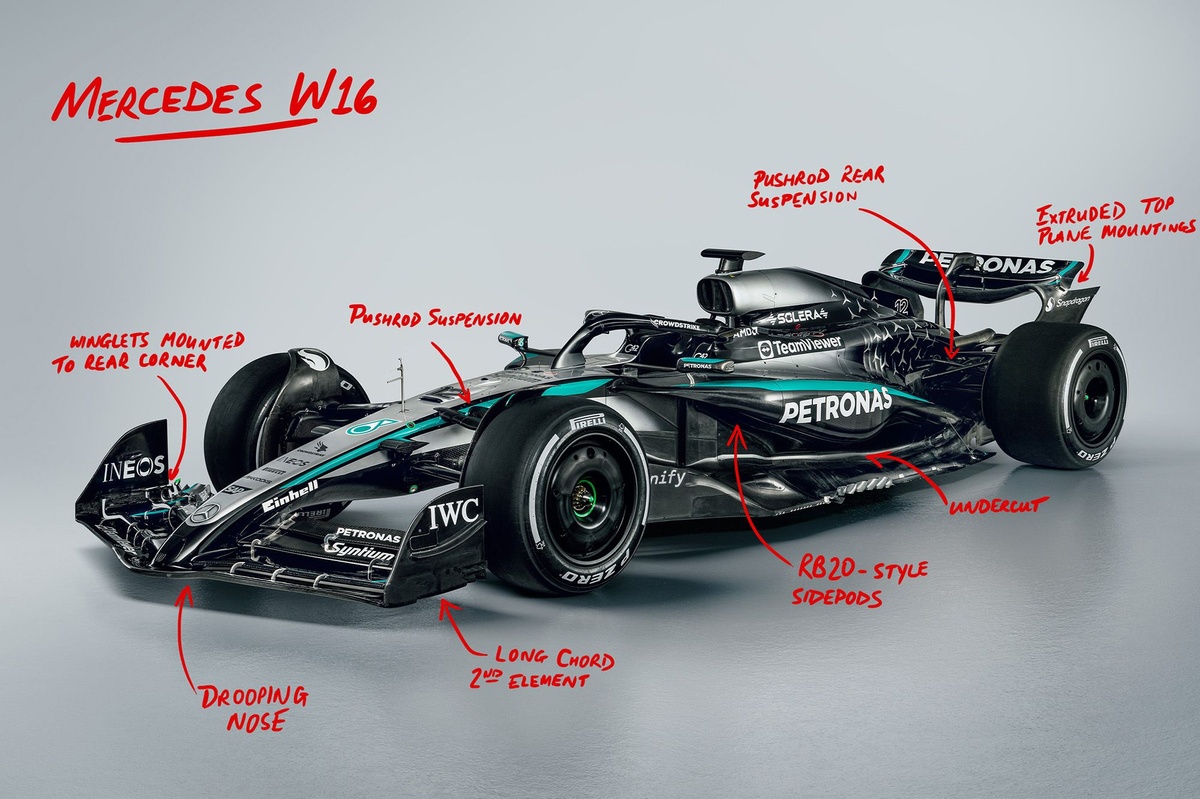
Visually, the W16 represents a significant departure from its predecessor, the W15, which itself was markedly different from the W14. It seems that Mercedes has been methodically exploring every possibility in its aerodynamics over the past three years, and the W16 is a culmination of this exhaustive process. One of the most notable features is the drooped, chiselled nose that extends further forward than before. This design places the tip of the nose halfway along the front wing’s mainplane, which is spoon-shaped in the center. The front wing’s architecture has been refined, with a relatively short-chord mainplane and a long-chord second element that extrudes forward at the junction with the endplate. The third and fourth elements, though shorter in chord, are adorned with a series of tiny details at their attachment points to the endplate, funneling airflow around the front tyre to mitigate wake turbulence on the floor. These intricate adjustments suggest a deep understanding of the car’s aerodynamic challenges and a commitment to addressing them comprehensively.
Sidepod Redesign and Cooling Solutions
One of the most significant changes in the W16 is the adoption of sidepod design cues from Red Bull’s RB20. The Mercedes sidepods now feature a fully integrated inlet overwing and split inlets: one recessed into the undercut and the other along the chassis bulkhead. This design allows for a large undercut beneath the sidepods, complete with a bulge underneath to prevent lift generation. The integrated inlet overwing and split inlets also provide crucial cooling for the radiators, which can now be housed more efficiently. This redesign is a clear indication that Mercedes has been paying close attention to the strategies of its competitors and is integrating those that show promise. The goal is to create a more stable and predictable car, one that can handle the rigors of various track conditions and maintain its performance throughout the season.
Rear Wing and Aerodynamic Integration
Mercedes has also made notable adjustments to the rear wing, similar to the approaches taken by Ferrari and Haas. The team has swept the mountings of the upper wing plane further forward, allowing the mainplane to be partially cut away where it meets the endplate. This configuration is designed to generate vortices that enhance the rear wing’s effectiveness and improve the car’s overall aerodynamic efficiency. By doing so, the team aims to create airflow patterns that not only boost downforce but also coordinate with the beam wing and the underbody flow. This integrated aerodynamic approach is crucial for ensuring that the W16 can maintain high speeds while being more predictable and controllable, a necessity for both experienced drivers and rookies.
The Challenge of Rookie Development
The introduction of rookie driver Andrea Kimi Antonelli adds another layer of complexity to the W16’s development. Antonelli, known for his precocious talent but relative inexperience, requires a car that is both fast and reliable to ensure he can acclimate to the demanding world of Formula 1. A year with last year’s W15 might have hindered his learning and development, making the need for a more predictable and manageable car paramount. George Russell, the more experienced driver, will play a critical role in leading the development of the W16 from the cockpit. His feedback will be invaluable, and he is expected to be a demanding influence on the team. Without the presence of Lewis Hamilton, whose aura and experience were significant assets, Russell’s leadership becomes even more crucial. He must not only pilot the car but also ensure that it meets the technical and performance standards necessary to challenge for race wins.
The Path to Title Contention
The W16 represents Mercedes’ final opportunity to leave a lasting mark on the current generation of Formula 1 cars. The team’s extensive aerodynamic and mechanical revisions are designed to make the car more predictable and manageable, all while maintaining or even improving its speed. The goal is to ensure that the W16 can consistently perform at a high level, providing a genuine challenge for race wins and podium finishes. The success of these changes will be pivotal in determining whether Mercedes can close the gap on the current leaders—McLaren, Ferrari, and Red Bull—and push back into the fight for titles. With the 2025 season on the horizon, the pressure is on for Mercedes to deliver a car that can not only compete but also inspire confidence in its drivers and fans.
Subscription and Further Insights
For those eager to delve deeper into the technical and strategic nuances of the W16 and other Formula 1 innovations, subscribing to Autosport Plus offers a wealth of in-depth analysis and real-time updates. Stay ahead of the game and gain exclusive insights into the developments that will shape the future of Formula 1.