
Racing Bulls: A Fresh Start with a New Look
Racing Bulls has made waves with its bold decision to switch to a white liveried car for the 2025 Formula 1 season. The VCARB 02, the team’s second car since its rebrand from AlphaTauri, stands out with its matte finish, a design choice that feels both contemporary and fitting. While white cars have not always been fan favorites, especially during the mid-2000s, the Racing Bulls’ approach has garnered significant praise. The team’s move to a cleaner, more minimalist aesthetic is a refreshing change, especially as it enters its tenth year with a design philosophy influenced by its sister team, Red Bull.
Evolutionary Design with Notable Upgrades
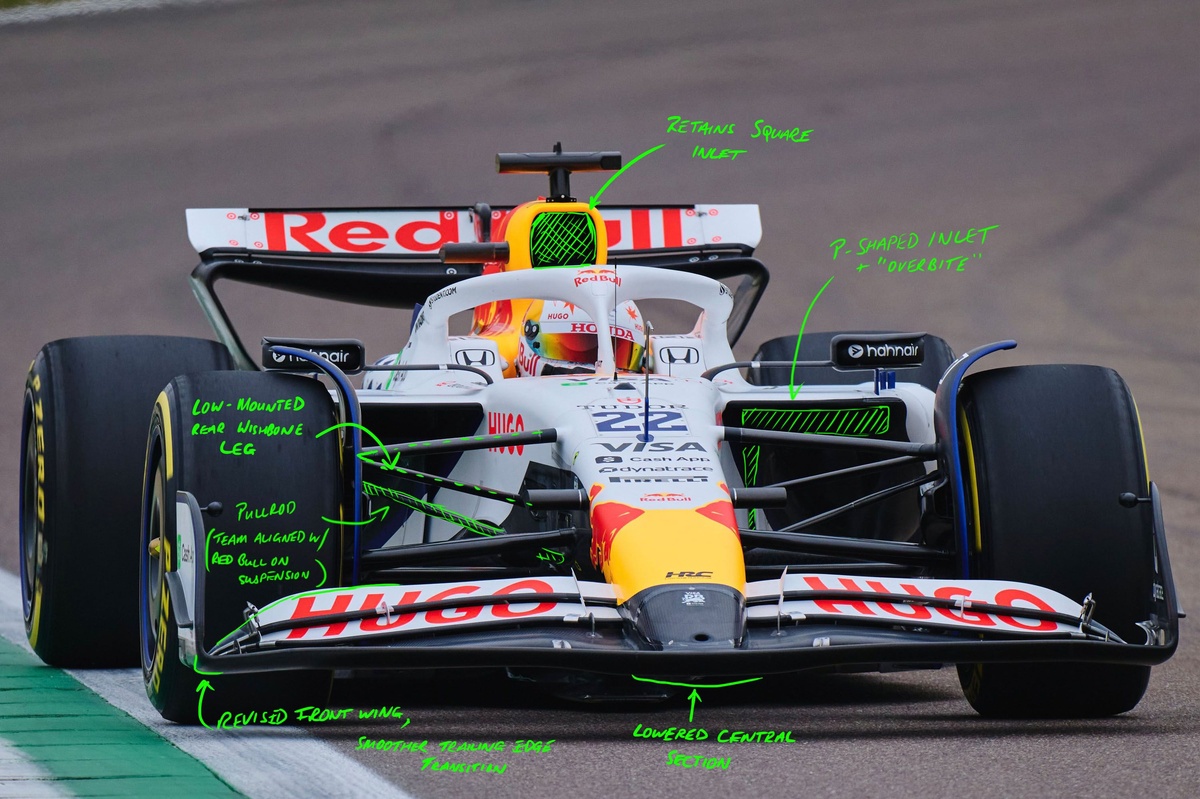
The VCARB 02 is an evolution of its predecessor, the VCARB 01, but it’s not without its notable upgrades. The car’s front suspension retains much of the same geometry, including the pull-rod formula and low-mounted rear leg of the upper wishbone. This design choice aligns with the direction Red Bull is taking for 2025, given the shared suspension layouts between the two teams. Notably, the team has reworked the brake duct assembly to better accommodate the pull-rod, a subtle yet significant improvement.
Embracing Modern Trends
One of the most striking changes in the VCARB 02 is the adoption of overbite sidepod inlets, a trend popularized by Red Bull and McLaren. These inlets, which are clearly visible in the enhanced images, follow a P-shaped design, featuring a vertical inlet along the chassis flanks. This design helps to optimize airflow and enhance performance, aligning the car with the latest aerodynamic trends in the sport. The high-shouldered engine cover and broader sidepod channels are retained, indicating the team’s focus on maintaining and refining the areas that have proven effective.
Subtle Enhancements to the Front Wing
The front wing of the VCARB 02 has undergone several refinements. Last year, the team opted for an angular, pointy nose and a front wing with a slightly raised section to channel more airflow underneath the car. For 2025, the nose has been reprofiled to droop slightly, lowering the central wing section and potentially reducing stagnating flow. The nose’s top surface has been smoothed out, and the wing elements have been reorganized, with a longer-chord second element and shorter top two elements.
New Endplates and Diveplanes
The front wing’s endplates have also been redesigned, featuring a curved leading edge and an S-shaped diveplane. These changes are aimed at redirecting airflow more efficiently around the car. The trailing edge of the wing has been smoothed out, and the flap adjuster mechanism has been moved slightly inboard to create more space for complex rear element junction points. These modifications, while subtle, are crucial for optimizing the car’s aerodynamic performance.
Strategic Moves and Future Prospects
Racing Bulls’ infrastructural changes have been just as significant as its technical upgrades. The team has moved its UK operations from Bicester to Milton Keynes, bringing it closer to Red Bull’s lead operations. This move not only addresses the previous facility’s limitations but also strengthens the technological links between the two teams. With the new wind tunnel scheduled to come online next year, Racing Bulls will be well-positioned to capitalize on the shared technology and resources.
Ambitions and Challenges Ahead
Team principal Laurent Mekies has set clear goals for the VCARB 02, focusing on improving the car’s consistency and overall performance. While the first part of the 2025 season may be challenging, the team is committed to investing heavily in improvements and leveraging its new facilities to achieve its ambitions. The aim is to finish sixth in the constructors’ championship, a target that will require the team to outperform its midfield rivals. Despite the tough competition, Racing Bulls is optimistic about its direction and the potential for growth in the coming years.
Conclusion
The 2025 season marks a new chapter for Racing Bulls, both visually and technologically. The VCARB 02 is a testament to the team’s commitment to evolution and improvement, even as it faces stiff competition from its peers. With a refreshed look, strategic infrastructure changes, and a strong focus on aerodynamic enhancements, Racing Bulls is poised to make a significant impact in the world of Formula 1. The team’s journey in 2025 will be one to watch, as it works towards achieving its ambitious goals and establishing itself as a formidable force in the sport.