
The Ferrari Shift: From London to Fiorano
On Tuesday evening, the glitzy and star-studded launch of Ferrari’s F1 car, the F175, took place at the iconic O2 Arena in London. It was a spectacle filled with anticipation and excitement, with fans and insiders alike eagerly awaiting the reveal of the livery. By Wednesday morning, the excitement had shifted to the hallowed grounds of Ferrari’s private test circuit in Fiorano. While some team members might have opted for a more budget-friendly Ryanair flight to Bologna, it’s far more likely that key personnel, including the likes of Lewis Hamilton, boarded a private jet. The idea of Hamilton, a Formula 1 megastar, enduring the discomfort of a Ryanair flight and battling the budget blues over a bag of Hula Hoops for £2.99 is almost too amusing to contemplate. Regardless, the SF-25 made its debut in Fiorano, following the reveal of its livery in London, showcasing a design that, while evolutionary, carries significant promise for the upcoming season.
Front Suspension Overhaul: A Strategic Move
One of the most notable changes in the SF-25 is Ferrari’s shift to pull-rod suspension at the front. This marked a departure from their successful push-rod design used in the previous season. The change in architecture was aimed at cleaning up the airflow around the car and providing greater scope for further aerodynamic development, as mentioned in Ferrari’s press release. The new design features a low wheel hub mounting for the pull-rod and a stacked lower wishbone on top of the steering arms. The reangled upper wishbone, with its rear leg raised upwards, contributes to a more refined dynamic setup, potentially improving stability and handling across a variety of corner types. This strategic move indicates that Ferrari is not content to rest on its laurels and is willing to explore new design directions to stay competitive.
Evolving Sidepod Design: A Focus on Aerodynamics
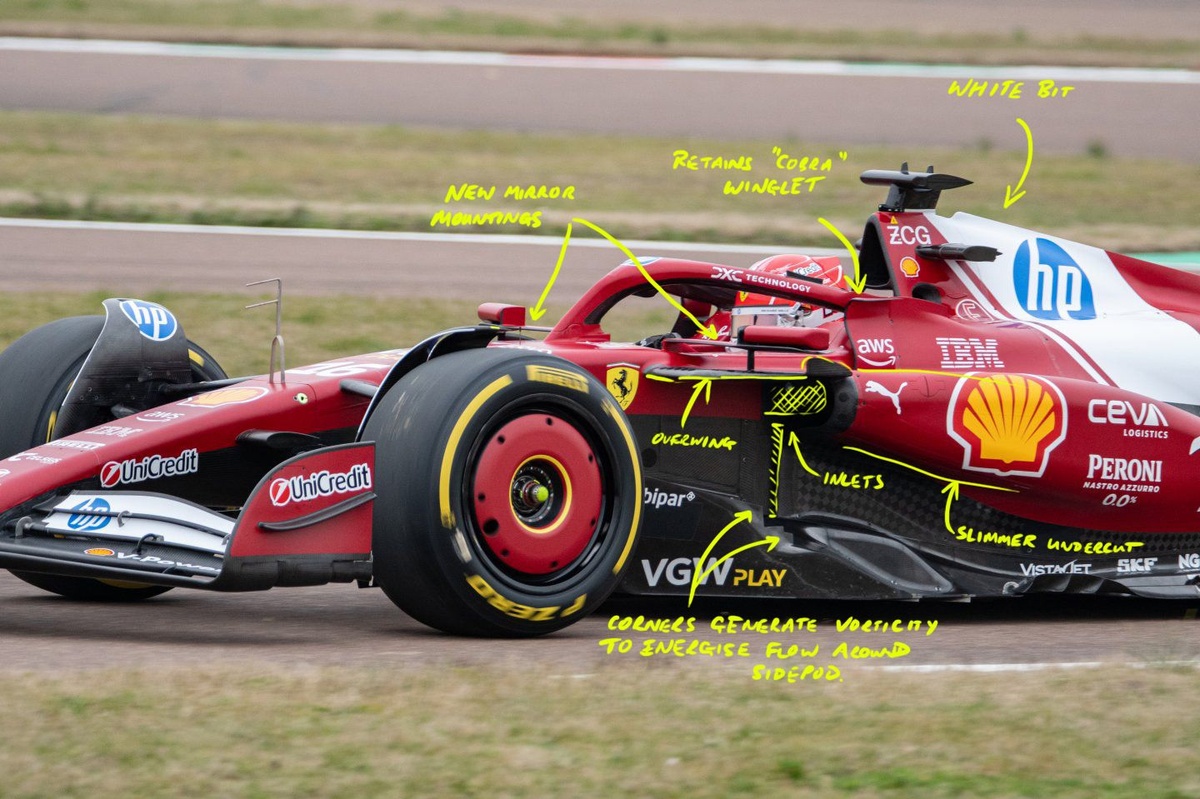
The SF-25’s sidepods have undergone significant changes, particularly around the air inlet. Ferrari introduced the ‘overbite’ layout partway through the 2024 season, and they have continued with this design, albeit with a McLaren-like treatment to the inlet shape. The sidepods feature a conventional semi-elliptical inlet with an extruded upper overwing that bends upwards at the tip to generate a vortex. This vortex helps energize the airflow passing over the top of the sidepods, promoting better cooling and aerodynamic efficiency. Additionally, the small letterbox inlets along the edge of the chassis serve dual purposes: they assist in the overall cooling system and can be used to duct airflow for aerodynamic benefits. The outer floor fence has also been equipped with exposed corners to further enhance airflow around the sidepod undercut, a design element that has been under experimentation in recent years due to the restrictive regulations.
Cockpit and Engine Cover Enhancements
Ferrari has retained the ‘cobra’ wings that sit on either side of the cockpit. These wings utilize a small area within the defined regulatory bounding boxes to help condition the airflow emerging from the front of the car and guide it around the engine cover. The engine cover itself has a noticeable reduction in the number of cooling louvres, a feature that can vary from race to race depending on temperature conditions. The bodywork flares out at the back, which aids in heat rejection. This design is particularly effective in warmer conditions, such as those typically encountered in Italy, where the car’s performance needs to be optimized for both cooling and aerodynamics. The rear end channel, created by the continued use of a trough on top of the sidepods, also contributes to better airflow management and downforce generation.
Rear Wing Innovations: Balancing Downforce and Drag
The rear wing of the SF-25 features a distinct V-shaped trough in the middle, a design that teams often employ to load the inboard section, which is the most effective area for generating downforce. The outboard parts are shallowed out to reduce drag while maintaining downforce, a crucial balance in Formula 1. The upper wing element is cut away from the mainplane, a trend that has gained popularity in recent years. This design ensures that the wing tips can generate vorticity, improving the wing’s overall effectiveness. Ferrari’s continued use of a pull-rod suspension layout at the rear, rather than switching to a push-rod, suggests a belief in the efficiency and space optimization of their current setup. The pull-rod design allows the rockers and springs to be placed on the top side of the gearbox, providing more room for the diffuser to expand and boost downforce output.
Seasonal Ambitions and Technical Evolution
Ferrari’s SF-25 is billed as a top-to-tail evolution of the previous car, reflecting the team’s commitment to continuous improvement and innovation. The 2024 season saw Ferrari develop well, particularly during the middle portion, which brought them into a competitive battle for the constructors’ championship. For the 2025 season, the goal is to build on this momentum and avoid the mid-season development pitfalls that have hampered their progress in the past. The new car’s subtle yet strategic changes, from front suspension to sidepod and rear wing design, indicate a well-thought-out approach to enhance performance and reliability. As the Prancing Horse aims for its first title of any kind since 2008, the technical evolution of the SF-25 will be crucial in determining whether they can achieve this long-awaited triumph.
Subscribe for In-Depth Analysis
For those eager to dive deeper into the technical and strategic details of Ferrari’s SF-25 and other Formula 1 developments, subscribing to Autosport Plus is highly recommended. The platform offers comprehensive analysis and insights, ensuring that fans and enthusiasts stay informed and engaged as the 2025 season unfolds. With the SF-25 making its debut, the stage is set for a thrilling and competitive year in Formula 1, and following these technical advancements will only add to the excitement.