
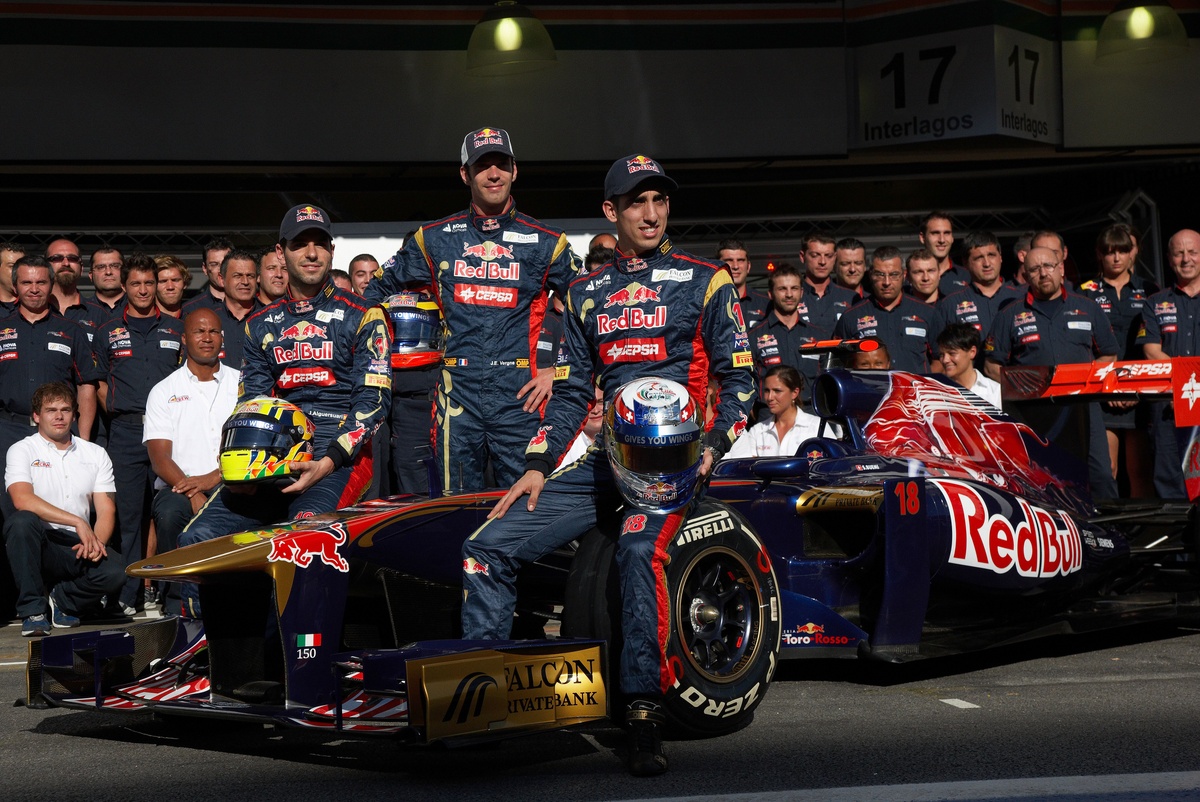
The Red Bull Young Driver Programme: A Mixed Legacy
While it’s easy to be cynical about the up-or-out nature of Red Bull’s young driver programme and the scars its abruptness has often left, no other enterprise has done more to promote young talent in motorsport. The list of drivers who have been through the system is vast and varied, with many finding success in other categories despite their F1 dreams being cut short. Some, like Max Verstappen and Sebastian Vettel, have gone on to become world champions, while others, like Christian Klien and Jaime Alguersuari, have faded into obscurity after brief and often tumultuous stints in the sport.
Enrique Bernoldi: The Finnish Affair
Enrique Bernoldi’s journey through the Red Bull system is a cautionary tale of how fortune can turn on a dime. In 2001, Dr. Helmut Marko, Red Bull’s motorsport advisor, was determined to secure a seat for Bernoldi at Sauber. However, Sauber chose the young Finnish sensation, Kimi Raikkonen, instead. Marko, in a fit of pique, moved Bernoldi to the struggling Arrows team, where he paired up with Jos Verstappen. Despite a three-year contract, Bernoldi’s F1 career was short-lived. Arrows’ financial troubles culminated in a surreal qualifying session at the French Grand Prix, where both drivers completed just one slow lap to meet championship requirements. After being briefly linked with Jordan, Bernoldi found himself shuffled off to other series, including GTs and Brazilian Stock Cars, before eventually leaving the Red Bull fold.
Christian Kliein: Fast-Tracked and Forgotten
Christian Klien, another Austrian talent, was fast-tracked through the junior formulae by Red Bull due to the underwhelming performance of Enrique Bernoldi. Klien joined Jaguar Racing in 2004, a team on the brink of collapse. Despite a few impressive moments, his F1 career was marked by inconsistency and a lack of support from the car’s competitiveness. After Red Bull acquired Jaguar Racing and rebranded it, Klien was put on a short leash. He shared the second seat with Mark Webber and Vitantonio Liuzzi, the latter of whom he famously collided with at the 2004 Belgian GP. By 2006, Klien found himself under threat from both Webber and Liuzzi. After a poor performance in the Ferrari-powered RB2, he was given the choice of a funded Champ Car drive or the exit door. Klien chose to leave, and his F1 career effectively ended. He later found success in GTs and the World Endurance Championship (WEC).
Patrick Friesacher: The Outlier
Patrick Friesacher is an outlier in this list. Initially dropped from the Red Bull Junior Team before reaching F1, he later rejoined the Red Bull family as a test driver and instructor. Friesacher showed promise in F3000 but was never quite convincing enough to secure a long-term F1 deal. He started 11 grands prix with Minardi in 2005 before financial constraints forced his replacement by Robert Doornbos. A back injury ended his single-seater career, but he made a brief return to racing in the American Le Mans Series in 2008. Today, Friesacher is a familiar face at the Red Bull Ring, where he instructs track days and participates in Red Bull demo runs.
Vitantonio Liuzzi: The Flamboyant Floundering
Vitantonio Liuzzi’s story is one of early promise and eventual disappointment. Backed by Red Bull through F3000, where he dominated in 2004, Liuzzi was initially talent-spotted by Williams. He made a brief but notable appearance in F1, first with Red Bull in 2005 and then with Toro Rosso in 2006. Known for his speed and flair, Liuzzi was also notorious for his fashion sense and sometimes rash driving style. His relationship with the team, particularly with team principal Franz Tost, was strained. At Monaco in 2007, he was castigated for a shunt at Massenet, which he insisted was caused by David Coulthard. By the middle of 2007, there were rumors of his imminent replacement. Liuzzi’s career took a dive, and he was eventually replaced by Sebastien Bourdais. After a period out of F1, he returned with Force India in 2009 and raced intermittently until 2011. He has since acted as an FIA driver steward.
Scott Speed: The American Dream
Scott Speed’s career with Red Bull was another example of the company’s original American-centric strategy. Dietrich Mateschitz, Red Bull’s founder, initially aimed to set up an American team to tap into the growing US market. Speed, along with AJ Allmendinger and Ryan Hunter-Reay, was part of the ‘Red Bull Driver Search’ programme. Despite health issues, including ulcerative colitis, Speed managed to secure a drive with Toro Rosso in 2006. However, his time with the team was marred by a lack of competitiveness and a notable altercation with team principal Franz Tost at the 2007 European GP. Speed was dropped in favor of Sebastian Vettel, and his F1 career seemed over. However, Red Bull supported him in NASCAR, where he raced until 2010. Since then, Speed has dabbled in rallycross and even Formula E, though his primary focus has shifted away from the highest levels of motorsport.
Sebastian Vettel: The Crown Jewel
Sebastian Vettel stands out as one of Red Bull’s greatest success stories. Talent-spotted in karting, Vettel quickly rose through the ranks, winning the Formula BMW ADAC championship in 2005 and impressing in Euro F3. Red Bull’s investment paid off when Vettel became the youngest-ever driver to score a point in F1 at the 2007 US GP. Promoted to Toro Rosso, he won the 2008 Italian GP, a feat that cemented his place in F1 history. Vettel’s career at Red Bull Racing was nothing short of stellar, with four consecutive world championships from 2010 to 2013. However, his relationship with the team became strained, particularly after the 2019 shock announcement that he would be replaced by Pierre Gasly. Vettel moved to Ferrari, where he enjoyed several successful years before a 2019 meltdown under pressure from Charles Leclerc. His time at Aston Martin was marked by eco-activism and a lack of results, leading to his retirement at the end of 2022. Despite the highs and lows, Vettel remains a towering figure in F1 history, a testament to Red Bull’s ability to nurture and promote exceptional talent.