

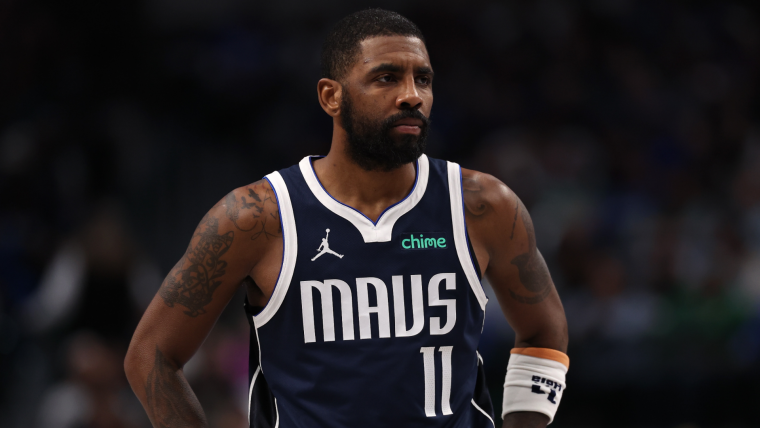
Kyrie Irving’s International Journey: From Team USA to Australia
Kyrie Irving, the Dallas Mavericks’ star point guard, has been a mainstay in the red, white, and blue of Team USA’s national basketball team. However, the nine-time All-Star is now contemplating a significant shift in his international allegiance, considering a move to represent his country of birth, Australia. Following the 2025 NBA All-Star Game, Irving’s thoughts on this potential switch have become more transparent. When questioned about his future with the Boomers, the Australian national team, Irving expressed a strong interest and admitted that the wheels are already in motion regarding his eligibility.
The Road to Representation
The process of switching international allegiances is far from simple, especially given Irving’s extensive history with Team USA. He has previously represented the United States in two major tournaments, earning gold medals at the 2014 FIBA Basketball World Cup and the 2016 Rio Olympics. Irving’s eligibility to play for Australia hinges on obtaining the necessary paperwork and garnering the approval of both the USA and Australian federations. FIBA regulations stipulate that both countries must agree to the change, and there is an exception that allows the Secretary General to authorize a nationality switch to a player’s ‘country of origin’ if it serves the development of basketball in that country. Irving, who holds dual American and Australian citizenship, is well within the bounds of this regulation, but the bureaucratic hurdles remain significant.
A Long-Standing Desire
Irving’s interest in playing for Australia is not a recent development. Born in Melbourne, where his father, Drederick, played professional basketball, Irving has always had a connection to Australia. Despite growing up in New Jersey, he has often referred to himself as an international player, citing his Australian roots. His comments on a Twitch stream last year further underscored this sentiment. “I consider myself an international player even though I played on Team USA,” he said. “A lot of my peers laugh at me when I bring it up, and some fans may not agree, but I was born in Australia. Team USA asked me to play for them when I was 17 or 18, and I wanted to play for Australia, but it just didn’t happen. Coach K wasn’t going to let that happen either.” This long-standing desire to represent Australia adds a personal and emotional dimension to his current considerations.
The Impact of Exclusion from Team USA
Irving’s exclusion from the final 12-man roster for the 2024 Paris Olympic Games, despite being initially selected in the 41-player pool for consideration, likely intensified his interest in switching allegiances. The snub from Team USA, a team he has loyally served and helped achieve significant victories, might have served as a catalyst for Irving to revisit his international options. The 32-year-old player, known for his elite skills and leadership, has not let this setback dampen his spirits. Instead, it seems to have rekindled his passion for potentially wearing the green and gold of the Boomers. This move would not only fulfill a personal dream but also bring a star-caliber player to a team that is already making waves in international basketball.
Irving’s Current Form and Future Prospects
Despite approaching his mid-30s, Irving remains a formidable force on the basketball court. For the 2022-2023 season, he has been instrumental in the Mavericks’ lineup, averaging 24.6 points, 4.8 assists, 4.8 rebounds, and 1.3 steals per game. His shooting efficiency is notable, with field goal percentages of 47.8%, 41.3% from three-point range, and 90.2% from the free-throw line. As the Mavericks sit at 30-26 and hold the eighth place in the Western Conference, Irving’s contributions are more critical than ever. His continued strong performance suggests that he still has a lot to offer, both in the NBA and potentially in international competitions. At 36, he could be a valuable veteran for the Boomers, providing leadership and experience in the 2028 Los Angeles Olympics.
The Ripple Effect on International Basketball
Irving’s potential switch to Australia could have far-reaching implications for international basketball. The Boomers, already a formidable team, would gain a superstar player who could elevate their status and performance on the global stage. This move could also inspire other players with dual citizenship to reconsider their international commitments, leading to a morepetitive com and dynamic international basketball landscape. For Irving, the decision to represent Australia would be a powerful statement, reflecting his deep-rooted connection to his birthplace and his commitment to contributing to the development of basketball in Australia. As he navigates the regulatory and personal considerations, the basketball world watches with bated breath, eagerly anticipating the outcome of this significant and potentially game-changing decision.