
UEFA Redraws the Map: New Format for European Competitions
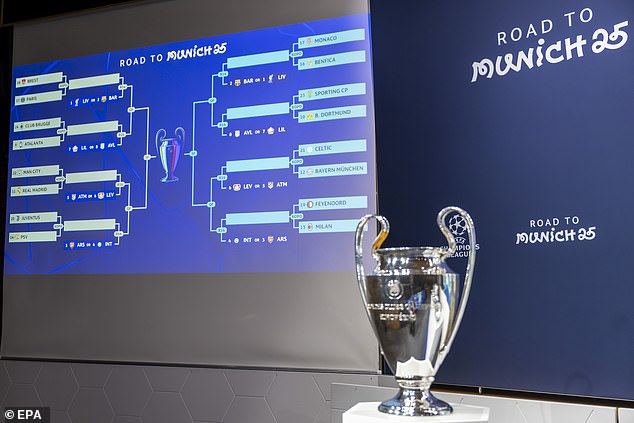
On Friday, European football fans will witness a new twist in the draws for the latter stages of the Champions League, Europa League, and Conference League. The draws, scheduled to begin at 11 am UK time, will take place at UEFA headquarters in Nyon, Switzerland. Unlike previous seasons, where all teams expected to see their club’s ball pulled from one of UEFA’s iconic semi-footballs, only eight balls will be presented in each competition this year. This change is due to the introduction of a ‘tennis’ style seeding system, which pairs teams that finished next to one another in the league phase and prevents them from meeting until the final. For the Champions League, the seeded pairs are Liverpool and Barcelona, Arsenal and Inter Milan, Atletico Madrid and Bayer Leverkusen, and Lille and Aston Villa. Each of these top eight sides will be joined in the last 16 by the winners of the two-legged knockout play-offs. The draws for the Europa League and Conference League will follow a similar format, with Manchester United, Tottenham, and Chelsea among the teams hoping for a favorable draw.
Positioning the Seeded Pairs: A Closer Look
The process of drawing the teams into the round of 16 is quite specific. For the Champions League, the eight balls representing the four seeded pairs will be placed in a bowl. Each ball will be marked to identify the teams within a pair, such as Liverpool and Barcelona. When a ball is drawn, the first team displayed will be placed on the silver side of the bracket, while the second will be placed on the blue side. This ensures that the teams in each pair will not meet until the final. For example, if Liverpool is drawn first from the Liverpool-Barcelona pair, they will face either Paris St-Germain or Benfica, who are the winners of the play-off round. The same process will be applied in the Europa League and Conference League, where Manchester United and Tottenham, as a seeded pair, can face either Real Sociedad or AZ Alkmaar. Chelsea, who topped the Conference League phase with a perfect record of six wins from six, will be drawn against either Real Betis or FC Copenhagen.
Seeding and Home Advantage in the Round of 16
The new format also includes a provision for home advantage in the round of 16. The seeded teams, having finished at the top of their respective pairs, will play the return matches of the two-legged tie at home. This not only rewards their performance in the league phase but also gives them a significant edge in the knockout stage. The first matches of these ties are set to take place in the first week of March, with the second legs following a week later. For instance, if Liverpool is drawn on the silver side of the bracket and faces PSG, they will play the first leg away and the second leg at home. This format ensures a fair and competitive distribution of home and away matches, adding an extra layer of strategy for the teams and excitement for the fans.
Deciding the Quarter-Finals and Semi-Finals
The draw for the quarter-finals and semi-finals will follow immediately after the round of 16 draw, adding a layer of anticipation and drama. For the Champions League, four bowls will be prepared for the quarter-final draw, with two bowls for the silver side of the bracket and two for the blue side. Each bowl will contain slips of paper marked with the winners of the round of 16 matches from the respective sides of the bracket. For example, the first silver bowl will have slips marked ‘Winners R16 1’ and ‘Winners R16 2’, while the second silver bowl will have ‘Winners R16 3’ and ‘Winners R16 4’. The same process will be followed for the blue side of the bracket. The first ball drawn from each bowl will determine which team plays the first leg at home, and the second ball will determine the home team for the return leg. This ensures that the draws are balanced and that no side has an unfair advantage in terms of home matches.
Semi-Finals and Final: The Final Steps
The semi-final draw will be conducted with a similar process but using only two bowls. One bowl will be prepared for the silver side of the bracket, containing slips marked ‘Winners Q-F 1’ and ‘Winners Q-F 2’, and another for the blue side with slips marked ‘Winners Q-F 3’ and ‘Winners Q-F 4’. The first ball drawn from each bowl will designate the home team for the first leg of the semi-final, and the second ball will determine the home team for the return leg. There is no draw for the final; the winners of the silver side of the bracket will be designated as the home team. This ensures a clear and straightforward path to the ultimate showdown, where the best teams will battle for continental glory.
New Clashes and Exciting Possibilities
One of the most notable changes this year is that teams from the same nation can now be drawn against one another in the round of 16. This opens up the possibility of intense, high-stakes matches between domestic rivals. In the Champions League, this could mean a clash between Bayern Munich and Bayer Leverkusen, or a thrilling Madrid derby between Real Madrid and Atletico Madrid. Similarly, in the Europa League, Manchester United and Tottenham could meet in a derby that promises to be a nail-biter. The draw also allows for teams to face sides they played in the league phase, such as Barcelona and Benfica. These matches add a new level of intrigue and challenge, making each round of the competition more exciting and unpredictable than ever before. Fans and pundits alike are eagerly anticipating the draw to see which teams will be pitted against each other in these critical stages of the European competitions.