
The Controversial Penalty Decision at Goodison Park
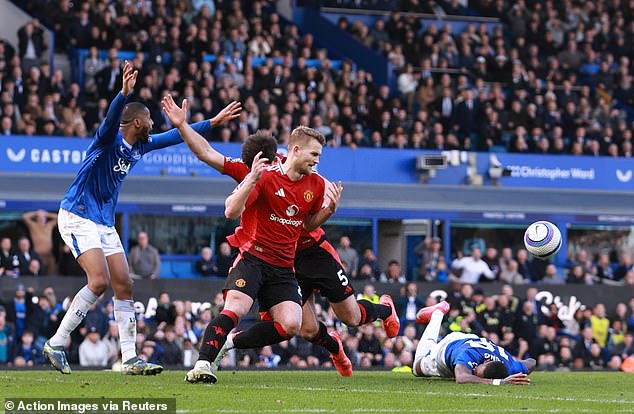
The final moments of Everton’s 2-2 draw with Manchester United at Goodison Park were nothing short of a rollercoaster. In the 93rd minute, the atmosphere in the stadium was electric as referee Andy Madley pointed to the spot, awarding a penalty to the Toffees. The decision came after former United player Ashley Young was sent crashing to the floor following a challenge inside the box by Harry Maguire and Matthijs De Ligt. Fans and players alike were jubilant, sensing a late victory that seemed within grasp after a hard-fought deadlock. However, their hopes were quickly dashed when Madley, after a lengthy consultation with VAR official Matthew Donohue, reversed his decision, leaving the game to end in a tense and unsatisfying draw.
Breakdown of the Incidents
The incident must be dissected into its separate moments to fully understand why the penalty was overturned. Initially, Madley awarded the penalty for what he perceived as a foul by Maguire on Young. Upon review, the footage showed Maguire with his hand on Young’s hip. However, the VAR concluded that Maguire did not make any significant effort to hold or pull Young, and thus, it was not enough to cause Young to fall to the ground. The VAR deemed Madley’s initial call a ‘clear and obvious error,’ necessitating the reversal. This decision hinged on the subtle but crucial distinction between incidental contact and deliberate fouling, which often leaves room for interpretation and controversy.
De Ligt’s Role in the Controversy
Another key aspect of the incident involved De Ligt, who was also seen engaging in contact with Young before the latter went to ground. According to ESPN, if Madley had penalized De Ligt for his actions, there would have been no VAR review. However, since the referee had initially penalized Maguire, VAR officials had to assess whether De Ligt’s actions warranted a review. While they did note that De Ligt was holding Young, they described this as a ‘fleeting’ incident and deemed Young’s subsequent fall as exaggerated. Consequently, De Ligt’s actions did not meet the threshold for a ‘clear and obvious error’ that would justify overturning the penalty decision.
The Role of VAR in the Decision-Making Process
The VAR’s role in this decision was particularly scrutinized, especially because Madley was only shown reviews from angles that centered on Maguire, the player he had initially penalized. This meant that Madley did not have the opportunity to see the goal-mouth camera angle, which might have provided a different perspective on the incident. The outcome of the review process is a testament to the limitations and potential biases in the VAR system, which can sometimes lead to decisions that seem counterintuitive to those on the ground. The slow pace of the VAR review, which was also noted for taking an unusually long time to confirm Everton’s opening goal, added to the frustration felt by the Toffees’ camp.
David Moyes’ Reaction to the Decision
After the match, Everton’s manager David Moyes was visibly incensed by the decision to overturn the penalty. In his post-match interview, Moyes expressed his confusion and disappointment, pointing out what he believed to be a clear foul. "I can’t understand. He (De Ligt) pulled his jersey," Moyes said. "I just thought the referee made the correct decision at the time and he should stick with it." Moyes’ frustration was palpable as he voiced his belief that the referee should have the authority to stand by his initial call if it is not a ‘clear and obvious error.’ He emphasized the importance of not undermining the referee’s judgment and the need for players to be held accountable for any form of jersey-pulling, which he sees as a clear foul.
The Broader Impact on the Match and the Issue of VAR
The overturned penalty not only affected the immediate outcome of the match but also reignited the debate surrounding the use of VAR in football. Many supporters and experts argue that while VAR is intended to correct significant errors, it often introduces new controversies and disrupts the flow of the game. The slow and sometimes inconclusive nature of VAR reviews can leave teams and fans feeling aggrieved, as was the case with Everton. Despite its flaws, the technology is here to stay, and it falls on the football authorities to continuously refine its implementation to ensure fair and swift decision-making. The incident at Goodison Park serves as a stark reminder of the challenges and complexities involved in the evolving relationship between human judgment and technological assistance in the beautiful game.