
Jaxson Dart’s Reckless Brilliance
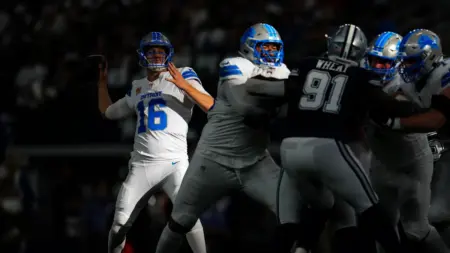
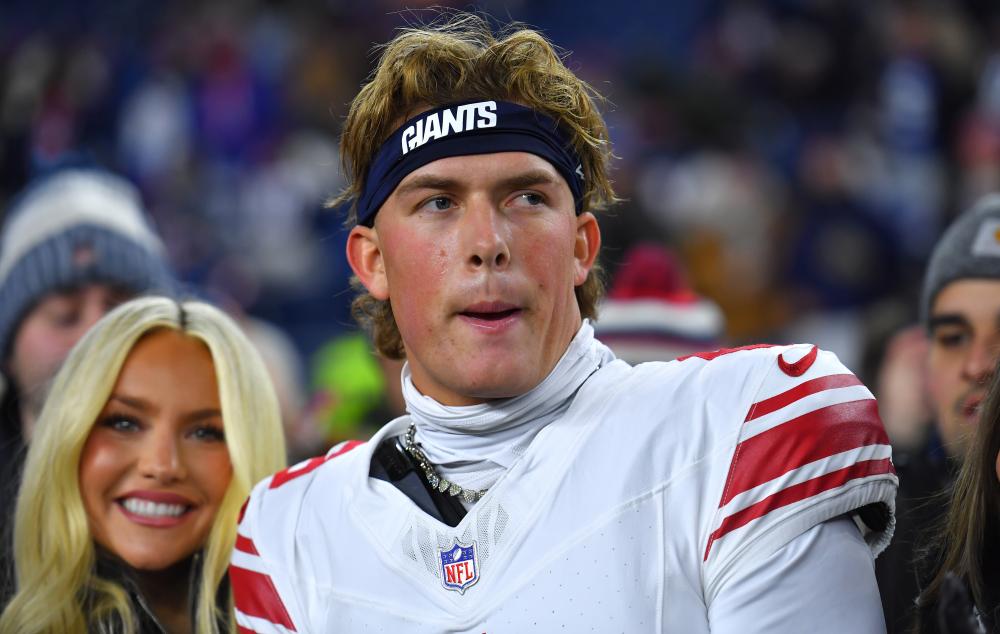
Jaxson Dart, the dynamic rookie quarterback for the New York Giants, wants you to understand that the game he plays is the real deal—tackle football, the kind where quarterbacks go airborne. After absorbing yet another bone-crushing hit, Dart brushed himself off and delivered a post-game sermon on toughness. “We’re not playing soccer,” he said. “You’re going to get hit. Things happen.” Yet, these “things” continue to happen to Dart at an alarming rate. In just his eight NFL starts, he has taken more unnecessary hits than any rookie quarterback in recent memory. On Monday night, Dart took another heavy hit near the sideline during the Giants’ 33-15 loss to the Patriots. Despite having the option to step out of bounds, he chose to lower his shoulder and was sent soaring through the air by Patriots linebacker Christian Elliss. The hit left even Peyton Manning, who was covering the game alongside his brother Eli, speechless. “Obviously, he told me he would run out of bounds if he was near the sideline,” Eli Manning said. “He lied to me.”
The Dilemma of Dart’s Recklessness
Dart’s reckless style has become the defining tension of his young career. He plays like a linebacker in a quarterback’s body, a throwback to a time when toughness was the ultimate currency. Fans and coaches love this old-school charm, but the physical toll is unsustainable. In a season filled with few bright spots, Dart has been a beacon of promise for the Giants. His dynamism has brought a jolt to an otherwise moribund offense, which is what the team expected when they traded up to draft him in the first round. However, the physical cost has been too steep. Dart has missed snaps and games due to taking unnecessary hits, not just absorbing them but often dishing them out. While his toughness is admirable, his availability is crucial. The rest of the locker room needs him on the field, for their own careers and the team’s success.
The Debate Over Dart’s Playing Style
Despite the risks, there is a segment of former players who see Dart’s recklessness as laudable. ESPN’s Dan Orlovsky, for instance, argued that it’s not OK to tell a player to be less competitive. “I don’t know when it became OK for us to tell a player to be less competitive,” Orlovsky said. But Orlovsky is missing the point. A quarterback refusing to embrace contact is not a sign of weakness; it’s a sign of wisdom. It’s about understanding the stakes and acknowledging that for the team to have a chance, the quarterback needs to stay upright. We know more than ever about the consequences of repetitive head impacts, including the risk of Chronic Traumatic Encephalopathy (CTE). In the past year alone, nine former and current NFL players under the age of 48 have died, seven of which were due to suicide or undisclosed reasons. While we can’t definitively link all these deaths to CTE, they highlight the long-term damage that repetitive head impacts can cause.
The Reality of Dart’s Injury Record
Dart’s style is not just dangerous to himself but to the future of the Giants. He has already been in the league’s concussion protocol four times in his rookie season, including preseason. In contrast, quarterbacks like Josh Allen and Patrick Mahomes, whom Dart often emulates, have had fewer documented head injuries. Allen has sustained one concussion in his career, while Mahomes has had three in 12 years. Dart, however, has already missed significant playing time due to concussions. In Chicago, a hit ruled him out for two weeks. During the pre-draft cycle, Jon Gruden, a renowned coach, warned Dart about his reckless style. “You’re a reckless son of a bitch,” Gruden said. “You’re kind of like Evel Knievel.” Dart grinned, thinking it was a compliment. Gruden kept hammering the point, predicting that Dart would often find himself in the concussion protocol tent. Dart admitted that it’s not smart, but he still wants to fall two yards forward every time he gets hit. This mindset is self-destructive and unsustainable in the NFL, where players are bigger, faster, and stronger, and the gaps close quicker.
The Giants’ Dilemma and Response
The Giants have lived with the consequences of Dart’s reckless play, hoping it would pay off. Head coach Brian Daboll, seen as a “quarterback whisperer,” leaned into Dart’s athleticism, using designed quarterback runs as the building blocks of the offense. In just seven starts under Daboll, Dart logged 25 designed carries, more than any other quarterback in the league. However, this approach faltered. Daboll was fired after the Giants started the season 2-8, in part because he failed to protect the young quarterback. The organization recognizes that the future of the franchise rests on Dart’s health and development. If he’s hurt, he cannot grow. His injury record already raises questions about his viability as a long-term starter. In his first start under interim coach Mike Kafka, Dart had zero designed rushing attempts, a clear effort to force him to alter his style. Yet, Dart still refused to give up on a play when the going was good, showing a stubbornness that may need to be addressed more forcefully.
The Path Forward for Jaxson Dart
Dart may insist that this is who he’s always been, and that’s fine. But the NFL is not high school or college football. The stakes are too high, and the punishment is too severe. The best quarterbacks develop a sixth sense for when the extra yard is worth the bruise and when it’s not. Dart’s impulse is currently off, and he plays as if pain is the point. While his style can be thrilling, it’s also unsustainable. The Giants need to protect Dart from himself, even if it means sitting him until he’s ready to take care of himself. Dart’s recklessness may be a double-edged sword, but the safety and longevity of his career should always come first. “We’re not playing soccer out here,” Dart said. No, he’s not. But this is the NFL, where the bravest thing a quarterback can sometimes do is step out of bounds and live to play another down.