
The Jets’ Quarterback Conundrum
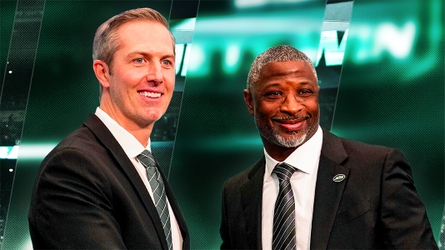
The New York Jets find themselves in a familiar yet precarious position: the need for a new quarterback. With future Hall of Famer Aaron Rodgers only expected to stay for one more season, the organization lacks a long-term solution at the most critical position. This responsibility falls squarely on the shoulders of Darren Mougey, the team’s general manager. Ultimately, his legacy in New York will be defined by his ability to secure a franchise quarterback, a challenge that is both daunting and essential.
Historical Context and Fan Impatience
This is the Jets’ first year under the new regime, but it has been 14 long years since they last made the playoffs. This extended drought has raised the bar for expectations and simultaneously shortened the honeymoon period typically afforded to new coaches and general managers. The pressure to find a franchise quarterback as soon as possible is immense, but making impulsive moves could be detrimental to the team’s future.
The 2023 Draft Class: A Mixed Bag
The 2023 quarterback class is not particularly strong, which complicates the Jets’ search. Cam Ward from Miami and Shedeur Sanders from Colorado are considered the top prospects, but they would likely be the fifth or sixth quarterbacks off the board if they were in last year’s draft, according to multiple sources. In comparison, Michael Penix, drafted eighth by the Falcons last year, is a far better prospect. J.J. McCarthy, who three sources told SNY would be the clear "Quarterback 1" of this year’s class, was drafted 11th by the Vikings. While arguments can be made for Sanders or Ward, especially if the Jets’ evaluation department is convinced of their future potential, the Jets currently sit at seventh in the draft order. To guarantee they get one of these top prospects, they would need to trade up to the first or second overall pick, a costly and risky proposition.
The Cost of Trading Up
Trading up to secure a quarterback is not a straightforward process. Each team has its own value chart for draft picks, and while there can be some discrepancies, the overall values are generally well-established. According to OverTheCap.com, the seventh pick has a value of 2,014, while the first and second picks are valued at 3,000 and 2,649, respectively. To move up, the Jets would need to make up at least 635 to 986 points, which could mean giving up a fourth to a low second-round pick. However, the actual cost of trading for a quarterback can be even higher. In 2023, the Panthers moved from No. 9 to No. 1, giving up their first-round pick and second-round pick in that draft, a first-round pick the following year, and a second-round pick two years later. The 49ers, in 2021, moved from No. 12 to No. 3 to draft Trey Lance, sacrificing a first-round pick that year, a first-round pick and fourth-round pick the next, and another first-round pick two years later. The Jets themselves have experience with such trades, moving from No. 6 to No. 3 in 2018 to select Sam Darnold, which cost them a first- and second-round pick that year, a second-round pick the next, and another second-round pick the following year. These overpays highlight the steep price of desperation.
Building the Roster: Immediate Needs and Financial Constraints
The Jets entered last season with high expectations, believing they could compete for a Super Bowl. They made significant investments, signing aging players and restructuring contracts with void years, but these efforts did not pay off. The team now faces numerous holes in their roster, including the need for a starting cornerback (DJ Reed is unlikely to return), defensive tackle, middle linebacker (C.J. Mosley’s future is uncertain and Jamien Sherwood is a free agent), wide receiver 2 and 3 (with Davante Adams and Allen Lazard expected to be released), right tackle (Morgan Moses is not expected to return), tight end (Tyler Conklin is a free agent), and two safeties. The Jets will have approximately $62 million in cap space, but only $52.5 million will be available at the start of free agency ($9.5 million is tied to Rodgers’ post-June 1 release). This limited financial flexibility means the team must prioritize wisely and maximize every dollar spent.
A Strategic Path Forward
Given the current state of the team and the weak quarterback class, the smartest move for the Jets might be to stay patient and strategic. Keep their draft picks, focus on rounding out the roster with depth, and perhaps take a chance on a quarterback like Jaxson Dart in the second or third round. The 2024 draft class, however, is projected to be much stronger, featuring prospects like Arch Manning, Nico Iamaleava, LaNorris Sellers, Garrett Nussmeier, and Drew Allar. By waiting until next year, the Jets can build a team that is truly one quarterback away from contention and trade up confidently, knowing they are providing a favorable environment for the new passer’s development.
Learning from Past Mistakes
The Jets’ last quarterback draft, where they selected Zach Wilson second overall in 2021, serves as a cautionary tale. They missed on Trevor Lawrence, the consensus top prospect, and settled for Wilson, whose performance has been disappointing. This year, the Jets should consider an alternate approach: trading the seventh pick to recoup assets and build a stronger foundation. They can then wait for a more opportune moment to secure a franchise quarterback. Desperation has led to costly and unsuccessful moves in the past; the Jets must avoid this trap to ensure the long-term success of the team.